
RBAK
Basic Aviation Knowledge for RPAS
Map position, direction, time, units, energy, lift, drag, weight and balance, propellers, controls and remote pilot station principles.
Part 101 MOS C10 Schedule 4, Unit 1, items 1-9.
Lessons
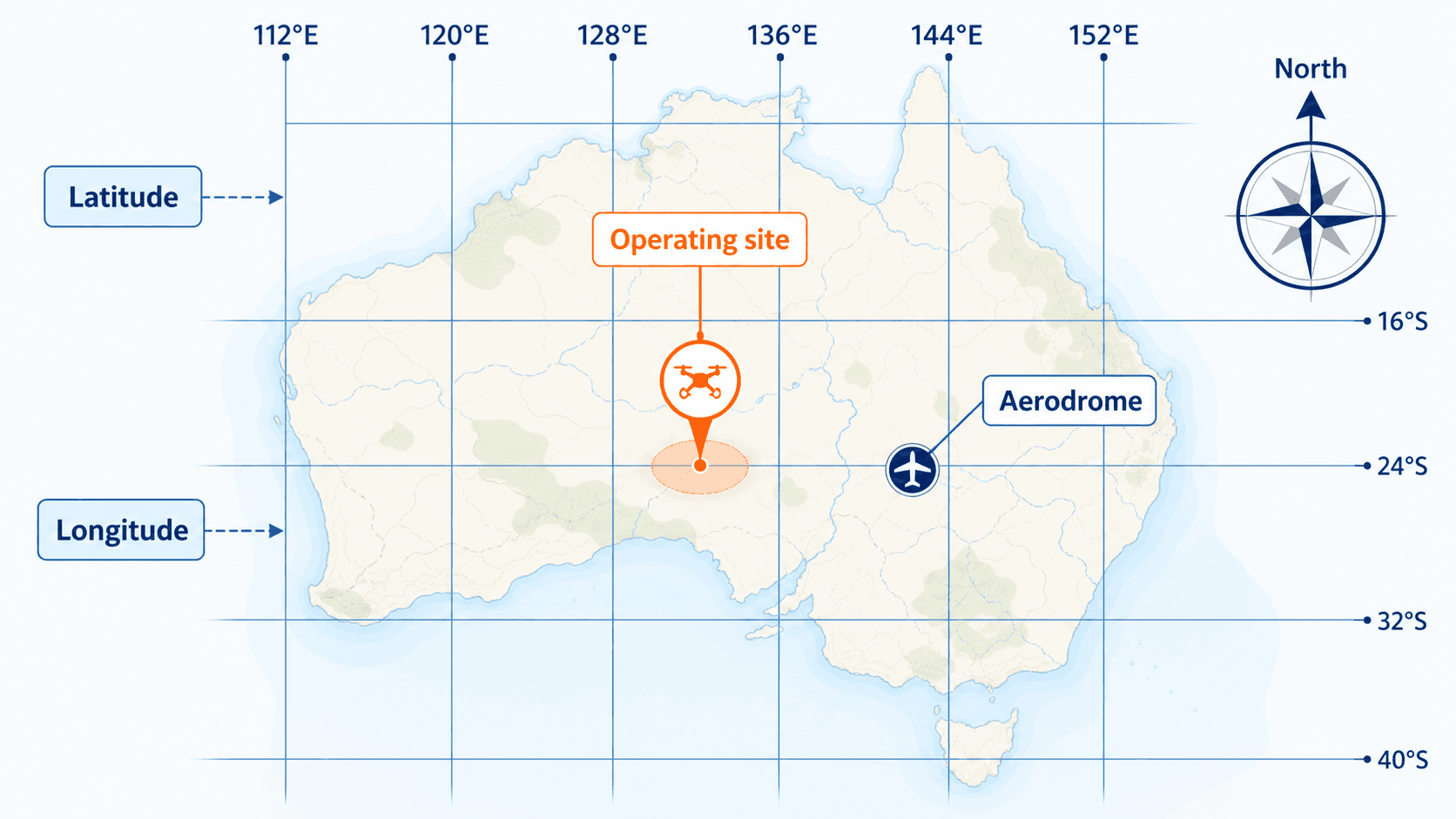
Map Position, Latitude/Longitude and Runway Orientation
Use latitude, longitude, true and magnetic direction, runway numbers and clock-code references to describe where an RPA operation is happening.
Source: RePL Study Guide pp. 11-29; Part 101 MOS C10 pp. 92-95.
Direction, Heading and Wind
Learn how aviation expresses direction, why heading and track are different, and how wind changes the path an RPA actually flies.
Source: RePL Study Guide pp. 11-35; Part 101 MOS C10 pp. 92-93.
Time, UTC and Date-Time Groups
Use aviation time correctly by reading four, six and eight figure groups and converting Australian local time to and from UTC.
Source: RePL Study Guide pp. 32-34; Part 101 MOS C10 p. 92.
Height, Altitude, Elevation and Aviation Units
Separate height, altitude and elevation, then apply the units remote pilots meet in aviation weather, charts and operations.
Source: RePL Study Guide pp. 29-35; Part 101 MOS C10 p. 92.
Aircraft Energy, Inertia and Speed
Understand potential energy, kinetic energy and inertia so aircraft behaviour, wind effects and stopping margin make practical sense.
Source: RePL Study Guide pp. 199-200; Part 101 MOS C10 p. 92.
Aerodynamics, Weight and Balance
Connect aerofoil terminology, forces, centre of gravity and loading limits to safe RPA operation.
Source: RePL Study Guide pp. 199-206; Part 101 MOS C10 pp. 92-93.
Lift, Drag and Angle of Attack
See how changes in airspeed and angle of attack affect lift, drag, stall margin and endurance.
Source: RePL Study Guide pp. 200-213; Part 101 MOS C10 p. 93.
Propellers, Rotors, Thrust and Torque
Understand blade angle, pitch, thrust, torque and why propeller or rotor condition matters before launch.
Source: RePL Study Guide pp. 166-172; Part 101 MOS C10 p. 93.
Flight Controls, Axes and Climb
Relate pitch, roll, yaw, power, climb angle and control inputs to what the aircraft actually does.
Source: RePL Study Guide pp. 188-198 and 220-224; Part 101 MOS C10 p. 93.
Remote Pilot Station and Control Link
Identify the remote pilot station features that support control, telemetry, software, antennas and non-payload communications.
Source: RePL Study Guide pp. 175-183; Part 101 MOS C10 p. 93.
Performance, Wind Shear, Turns and Ground Effect
Preserve performance margin when weight, wind, heat, height, turns and descent airflow make the aircraft work harder.
Source: RePL Study Guide pp. 215-236; Part 101 MOS C10 pp. 92-95; CASA AC 101-01 v6.1 and AC 101-03 v2.0 checked 2026-05-19.
Next step after study
Complete your Remote Pilot Licence training
The free study guide is a strong theory foundation. To actually be issued with a RePL, students still complete approved training, practical flying and assessment with a certified provider.
Unit MOS coverage
RBAK item 1: Direction of flight, bearings and orientation
Priority A - Part 101 MOS C10 Schedule 4 Unit 1 Item 1
RACP item 1-3: Airspace, charts and aviation publications
Priority A - Part 101 MOS C10 Schedule 4 Unit 2 Items 1-3
RBAK item 1: Direction of flight and wind
Priority A - Part 101 MOS C10 Schedule 4 Unit 1 Item 1
RBAK item 2: Time
Priority B - Part 101 MOS C10 Schedule 4 Unit 1 Item 2
RBAK item 3: Units of measurement for aeronautics
Priority A - Part 101 MOS C10 Schedule 4 Unit 1 Item 3
RBAK item 4: Energy
Priority B - Part 101 MOS C10 Schedule 4 Unit 1 Item 4
RBAK item 5: Aerodynamics, weight and balance
Priority A - Part 101 MOS C10 Schedule 4 Unit 1 Item 5
RBAK item 6: Lift and drag
Priority B - Part 101 MOS C10 Schedule 4 Unit 1 Item 6
RBAK item 7: Propellers and rotors
Priority B - Part 101 MOS C10 Schedule 4 Unit 1 Item 7
RBAK item 8: Principles of operation - flight control
Priority A - Part 101 MOS C10 Schedule 4 Unit 1 Item 8
RBAK item 9: Principles of operation - remote pilot station
Priority C - Part 101 MOS C10 Schedule 4 Unit 1 Item 9
RBAK item 1-8: Direction, wind, energy, lift, drag, weight, controls, climb and descent
Priority A - Part 101 MOS C10 Schedule 4 Unit 1 Items 1-8
RBKM item 6-10: Abnormal operations, launch, climb, turns, descent and recovery
Priority A - Part 101 MOS C10 Schedule 4 Unit 10 Items 6-10