
RBAK - Basic Aviation Knowledge
Aircraft Energy, Inertia and Speed
Understand potential energy, kinetic energy and inertia so aircraft behaviour, wind effects and stopping margin make practical sense.
Lesson references
- Last reviewed
- 2026-05-18
- Lesson references
- RePL Study Guide pp. 199-200; Part 101 MOS C10 p. 92.
Energy is the aircraft's work budget
A drone is always managing energy. Battery power turns the propellers, the propellers create thrust, thrust creates movement, and movement gives the aircraft momentum.
For study, the MOS keeps this topic simple: know potential energy, kinetic energy and inertia. For flying, the useful habit is even simpler: more height, more speed or more mass means the aircraft needs more respect and more margin.
Potential energy is height
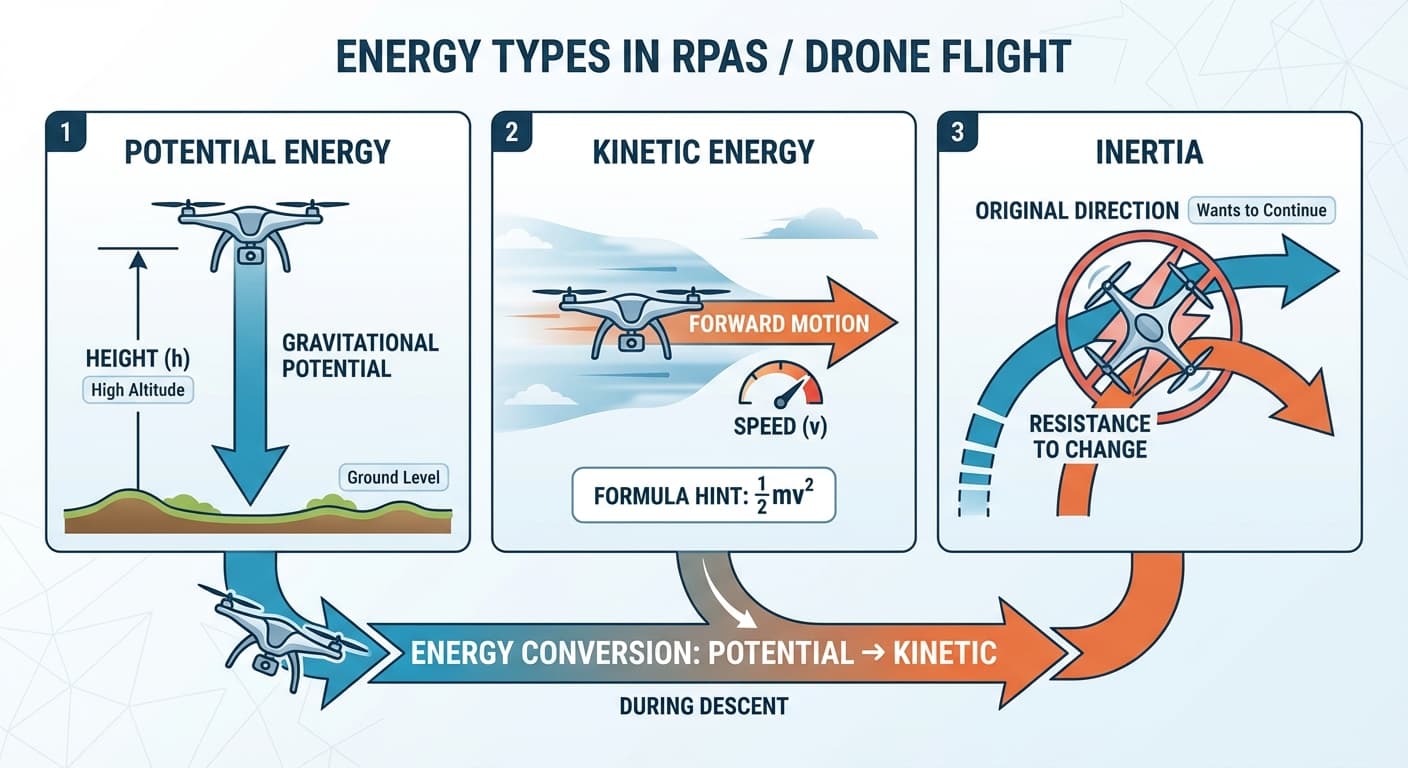
Potential energy is stored by position. In this lesson, that mainly means height above the ground. A drone at 120 m AGL has more stored energy than the same drone at 20 m AGL because gravity has more room to accelerate it during an uncontrolled descent.
That does not mean height is automatically unsafe. Height can also provide obstacle clearance and time to respond. The point is to plan it deliberately: choose a return-to-home height, climb and descent path, and emergency landing area that match the site.
- More height can give more time to think, but also more energy to manage.
- A descent is an energy change: stored height is being traded for movement and rotor work.
- Return-to-home height should clear obstacles without creating unnecessary exposure.
Kinetic energy is motion
Kinetic energy is the energy of motion. A moving aircraft cannot stop instantly because the propellers, flight controller and air resistance need time and distance to change what the aircraft is doing.
Speed matters twice in practice. It reduces the time you have to recognise a problem, and it increases the distance the aircraft will travel while it is slowing, turning or correcting after a gust.
Inertia is why decisions need margin
Inertia is the tendency of an object to keep doing what it is already doing. If the drone is moving forward, it tends to keep moving forward. If it is descending, it tends to keep descending until enough upward force changes that trend.
This is why good remote pilots make early, smooth corrections. Waiting until the aircraft is close to a tree, building, bystander or boundary leaves the flight controller with less room to turn pilot intent into aircraft movement.
- A heavier aircraft has more inertia than a lighter aircraft at the same speed.
- A faster aircraft has more kinetic energy than a slower aircraft of the same mass.
- A payload can increase mass, change balance and make the aircraft feel less eager to stop or climb.
Wind changes the energy story
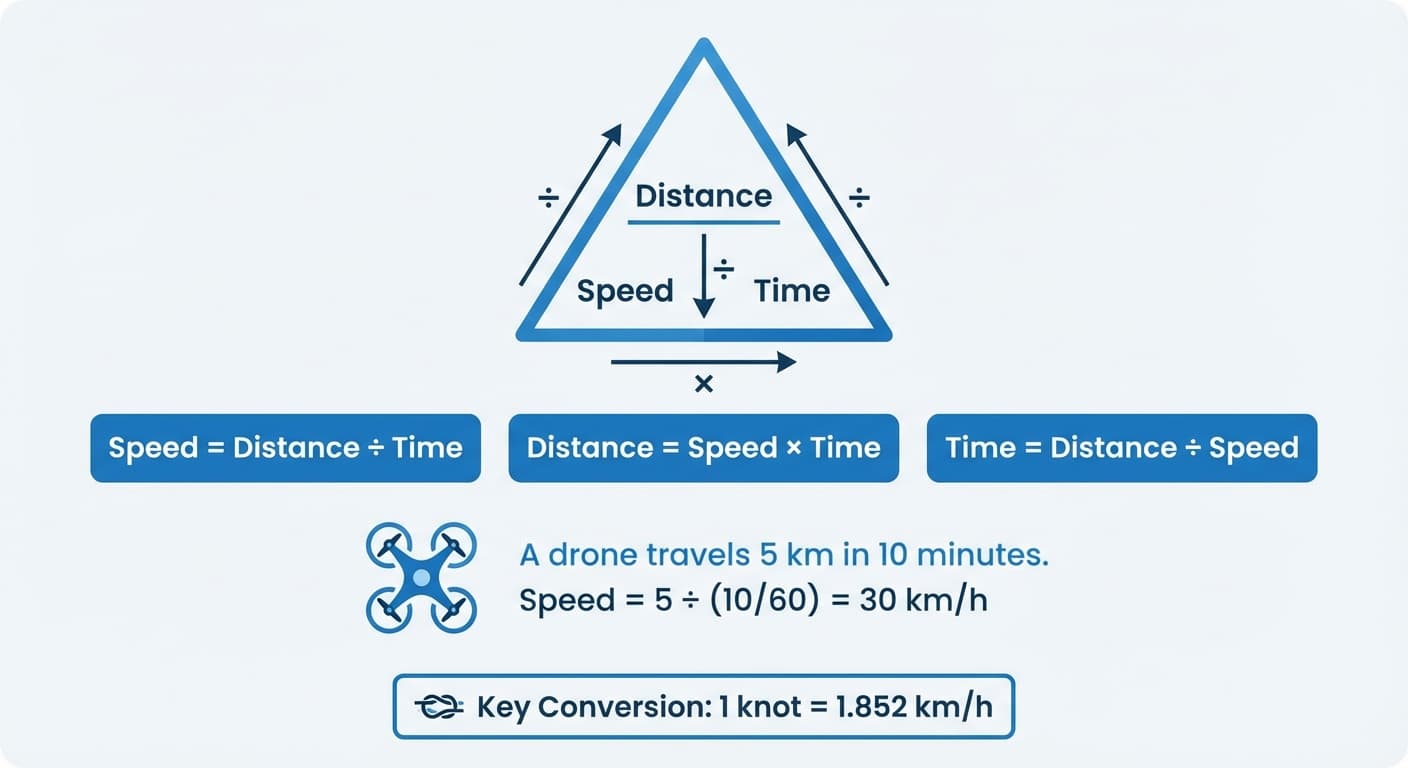
The aircraft flies in moving air, but the pilot often judges the mission over the ground. Into wind, a drone may need more power to make the same ground progress. Downwind, the same aircraft can cover ground faster than expected.
That difference matters near people, obstacles and operational boundaries. A downwind leg can eat up distance quickly; an into-wind return can eat up battery. Energy management and wind awareness belong together.
- Plan the return leg with wind in mind, not just the outbound leg.
- Leave more stopping and turning room when groundspeed is high.
- Treat gusts as energy changes: the aircraft may suddenly speed up, slow down, climb, sink or drift.
What this means for remote pilots
The practical lesson is not to do physics in your head during every flight. It is to recognise when the aircraft has more energy than usual and adjust the plan before that matters.
High speed, extra payload, high return-to-home settings, steep descents, strong wind and tight operating areas all deserve earlier decisions and bigger margins.
- Slow down before entering a confined area.
- Start descent planning early instead of dropping steeply at the end.
- Keep enough battery reserve for the into-wind return.
- Give heavier or payload-carrying RPA more room to stop, climb and turn.
Practice Questions
Which statement best describes kinetic energy?
- Energy associated with motion.
- Energy associated only with temperature.
- Energy associated only with battery voltage.
- Energy that exists only while landed.
Answer: Energy associated with motion.
Kinetic energy increases with motion and is an important part of aircraft performance and impact risk.
A drone is returning downwind toward the pilot faster than expected. What is the best energy-management response?
- Reduce speed early and allow more stopping distance.
- Wait until the drone is very close, then brake hard.
- Ignore the wind because multirotors hover.
- Climb immediately regardless of obstacles or airspace.
Answer: Reduce speed early and allow more stopping distance.
Downwind groundspeed can build quickly. Early speed control gives the aircraft more room and time to slow or turn safely.
Why can a payload-carrying RPA need more margin than the same aircraft without payload?
- More mass can increase inertia and affect stopping, climb and handling.
- Payload always reduces wind to zero.
- Payload removes kinetic energy from the aircraft.
- A heavier aircraft is automatically exempt from operating limits.
Answer: More mass can increase inertia and affect stopping, climb and handling.
Additional mass means the aircraft may resist changes in motion more strongly, so the pilot should allow more operating margin.
Next step after study
Complete your Remote Pilot Licence training
The free study guide is a strong theory foundation. To actually be issued with a RePL, students still complete approved training, practical flying and assessment with a certified provider.