
RBAK - Basic Aviation Knowledge
Time, UTC and Date-Time Groups
Use aviation time correctly by reading four, six and eight figure groups and converting Australian local time to and from UTC.
Lesson references
- Last reviewed
- 2026-05-18
- Lesson references
- RePL Study Guide pp. 32-34; Part 101 MOS C10 p. 92.
Aviation needs one shared clock
Local civil time is useful on the ground, but aviation information needs a common reference. Weather, NOTAMs and operational coordination use Universal Coordinated Time, normally written as UTC.
A four figure group gives the hour and minutes on the 24 hour clock. For example, 0525 means 5:25 am UTC, while 1525 means 3:25 pm UTC.
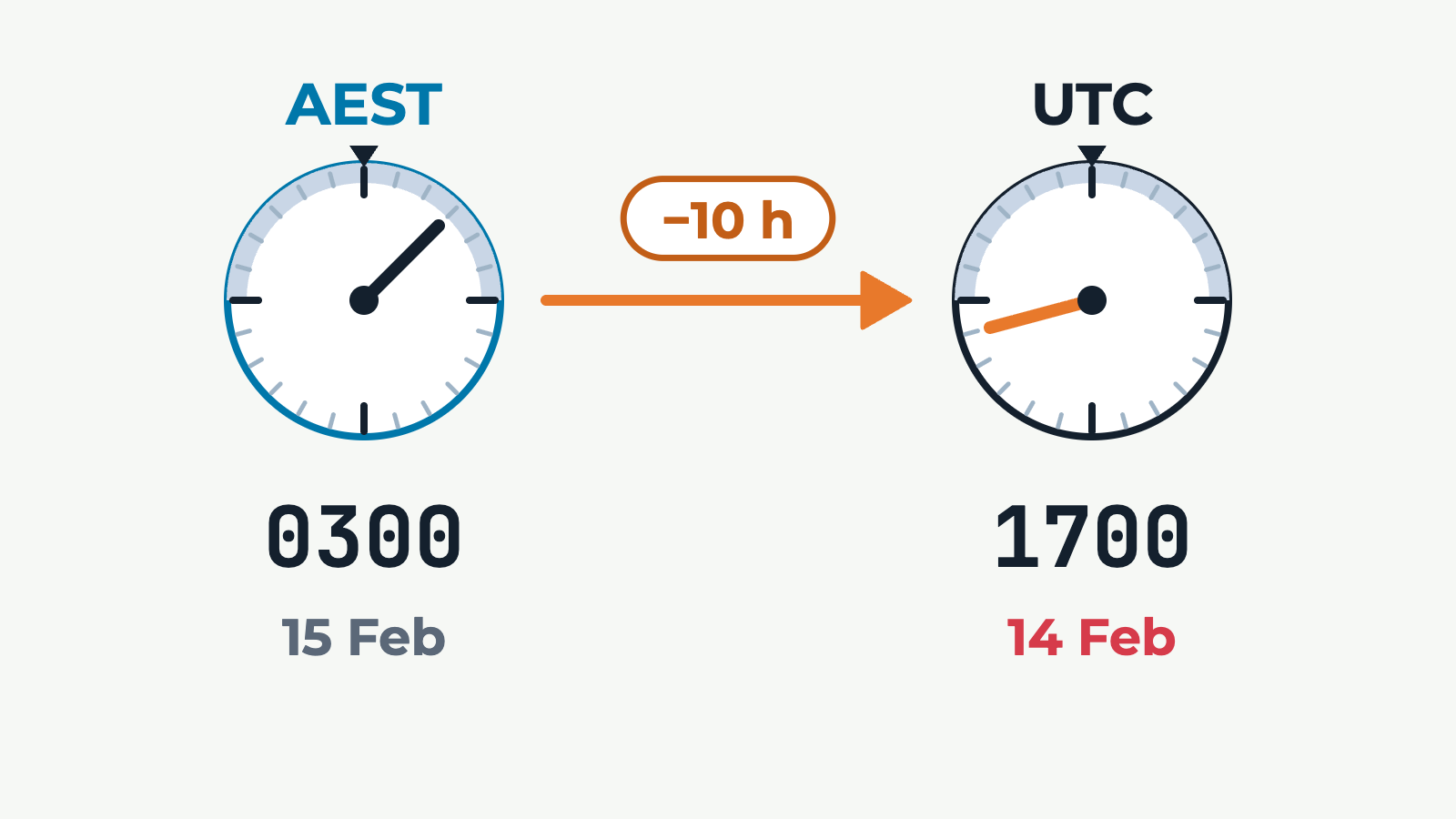
Two 24-hour dials side by side: local time on the left, UTC on the right, each with midnight at the top and a digital four-figure time and date underneath. Example 1: 2300 AEST on 15 February; the UTC hand turns back 10 hours to 1300 UTC, same date. Example 2: 0500 UTC; the local hand turns forward 10 hours to 1500 AEST. Example 3: 0300 AEST on 15 February; turning back 10 hours passes midnight, so the result is 1700 UTC on 14 February, the previous date. Buttons change the local zone (AWST UTC+8, ACST UTC+9.5, AEST UTC+10) and daylight saving (ACDT UTC+10.5, AEDT UTC+11; Western Australia has none). UTC itself never changes.
Australian conversions need the date as well as the hour
Eastern Standard Time is 10 hours ahead of UTC. To convert EST to UTC, subtract 10 hours. If that takes you before midnight, the UTC time is on the previous date.
The trap is assuming the date remains unchanged. A NOTAM or weather validity time near midnight can belong to yesterday or tomorrow in local time.
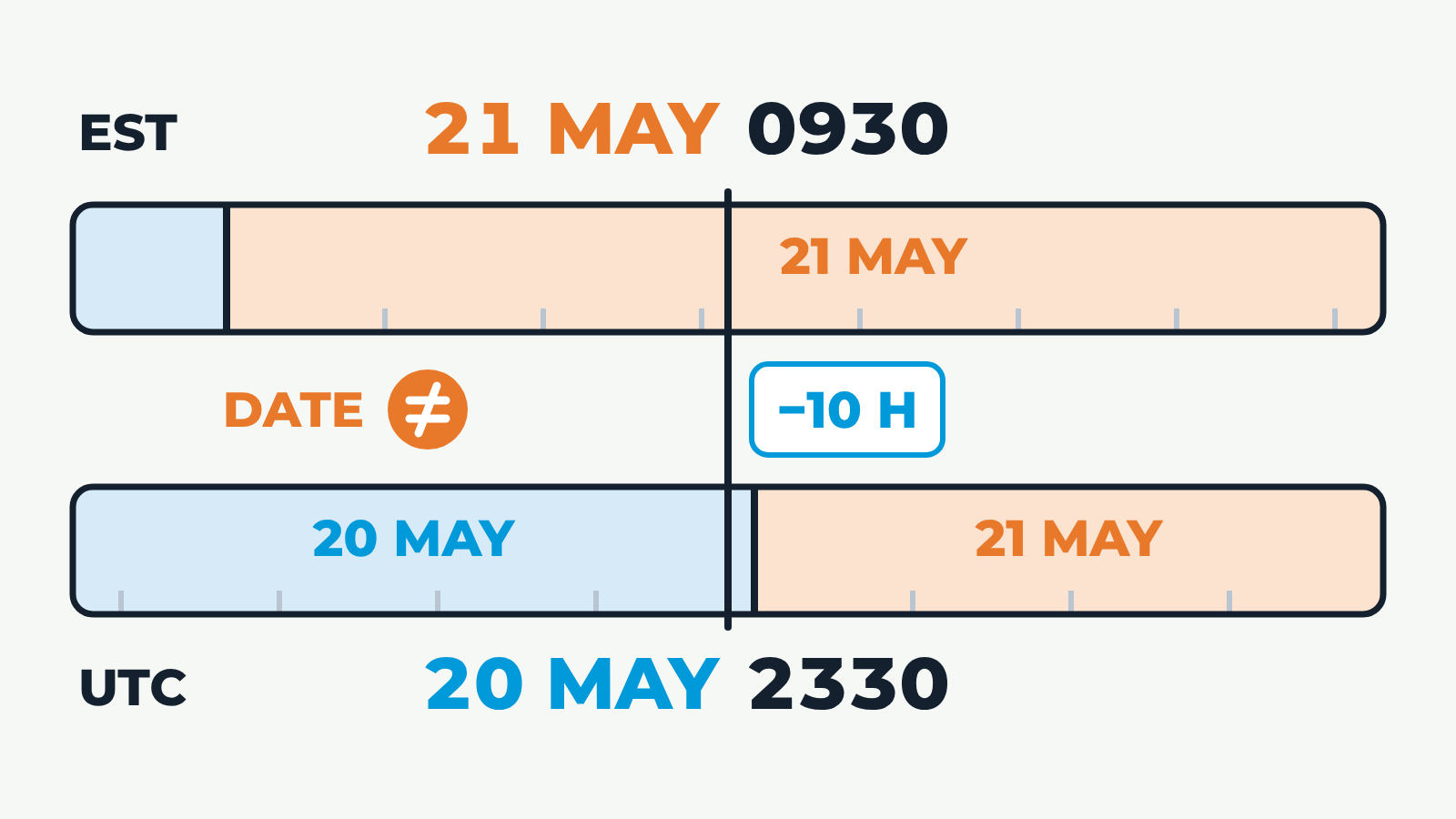
A 12 second loop with two day strips, one for Eastern Standard Time on top and one for UTC below, shifted 10 hours apart. A vertical now-line crosses both strips, and readouts show the local and UTC date and time. Local time sweeps from 0700 to 1200 on 21 May. While local time is before 1000, the UTC strip is still on 20 May. At 1000 local, UTC passes midnight and its date changes to 21 May. The sweep then returns to the lesson example, 21 May 0930 EST, which is 20 May 2330 UTC: subtract 10 hours, then check the date. A slider lets the learner set the local time directly. The still frame shows the 0930 example.
- Four figures usually mean hour and minute.
- Six figures usually mean day, hour and minute.
- Eight or ten figures can add month and year when the wider date context is needed.
Use date-time groups operationally
Remote pilots should be comfortable turning local job times into UTC for flight planning and reading UTC information back into local time for the crew.
When the operation depends on a NOTAM, forecast window or approval time, write the local and UTC interpretation in the job pack. That small habit prevents avoidable timing errors.
Practice Questions
If it is 1525 EST, what is the UTC time?
- 0525 UTC
- 1525 UTC
- 0125 UTC
- 2525 UTC
Answer: 0525 UTC
Eastern Standard Time is UTC plus 10 hours, so subtract 10 hours to convert EST to UTC.
You plan to launch at 0600 AEST (Brisbane local time) on 3 March. NOTAMs are published in UTC. What is your launch time in UTC?
- 1600 UTC on 3 March
- 2000 UTC on 3 March
- 0400 UTC on 3 March
- 2000 UTC on 2 March
Answer: 2000 UTC on 2 March
UTC = local time − 10 hours for AEST. 0600 − 10 gives −0400, so add 24 and go back one day: 2000 UTC on 2 March.
Next step after study
Complete your Remote Pilot Licence training
The free study guide is a strong theory foundation. To actually be issued with a RePL, students still complete approved training, practical flying and assessment with a certified provider.