
RBAK - Basic Aviation Knowledge
Propellers, Rotors, Thrust and Torque
Understand blade angle, pitch, thrust, torque and why propeller or rotor condition matters before launch.
Lesson references
- Last reviewed
- 2026-05-18
- Lesson references
- RePL Study Guide pp. 166-172; Part 101 MOS C10 p. 93.
A propeller is a rotating wing
Propellers and rotor blades create thrust by accelerating air. Blade angle, helix angle and pitch describe how the blade meets the air as it rotates.
A damaged, incorrectly installed or mismatched propeller can reduce lift, increase vibration, increase current draw and compromise control.
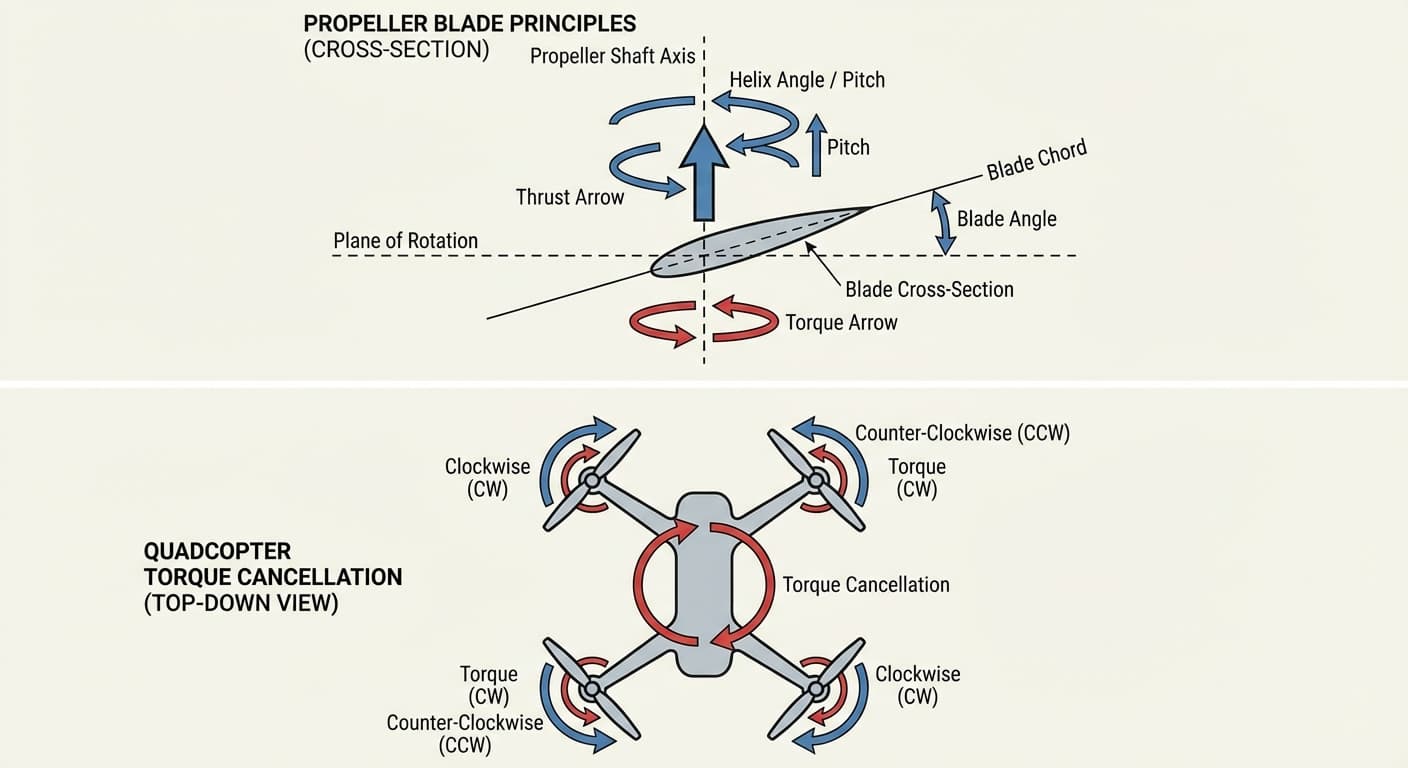
Torque has to be managed
When a motor turns a propeller or rotor one way, an opposite torque reaction acts on the aircraft. Multirotors manage this with opposing rotor directions and flight controller mixing.
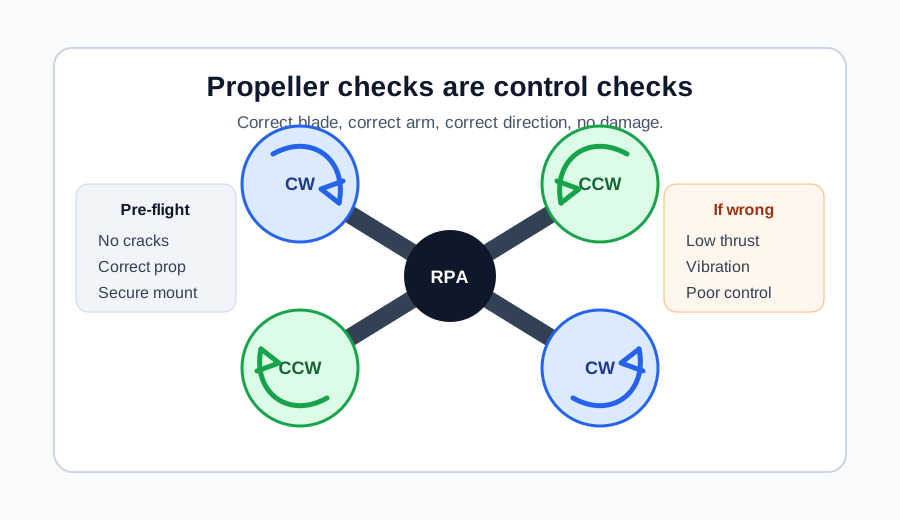
That is why propeller position and direction matter. A propeller fitted to the wrong arm or upside down may still spin, but it will not produce the expected thrust.
Pre-flight checks are aerodynamic checks
Checking propellers is not just a mechanical habit. It verifies the aircraft still has the aerodynamic surfaces it needs to generate predictable thrust.
Look for cracks, chips, deformation, loose mounts, wrong prop type and contamination before flight.
Practice Questions
Why is an incorrectly installed multirotor propeller dangerous?
- It may not produce the expected thrust or torque balance.
- It automatically improves GPS hold.
- It only affects the aircraft lights.
- It has no effect if the motor spins.
Answer: It may not produce the expected thrust or torque balance.
Propeller direction, pitch and position are critical to thrust and aircraft control.
Next step after study
Complete your Remote Pilot Licence training
The free study guide is a strong theory foundation. To actually be issued with a RePL, students still complete approved training, practical flying and assessment with a certified provider.