
RBAK - Basic Aviation Knowledge
Flight Controls, Axes and Climb
Relate pitch, roll, yaw, power, climb angle and control inputs to what the aircraft actually does.
Lesson references
- Last reviewed
- 2026-05-18
- Lesson references
- RePL Study Guide pp. 188-198 and 220-224; Part 101 MOS C10 p. 93.
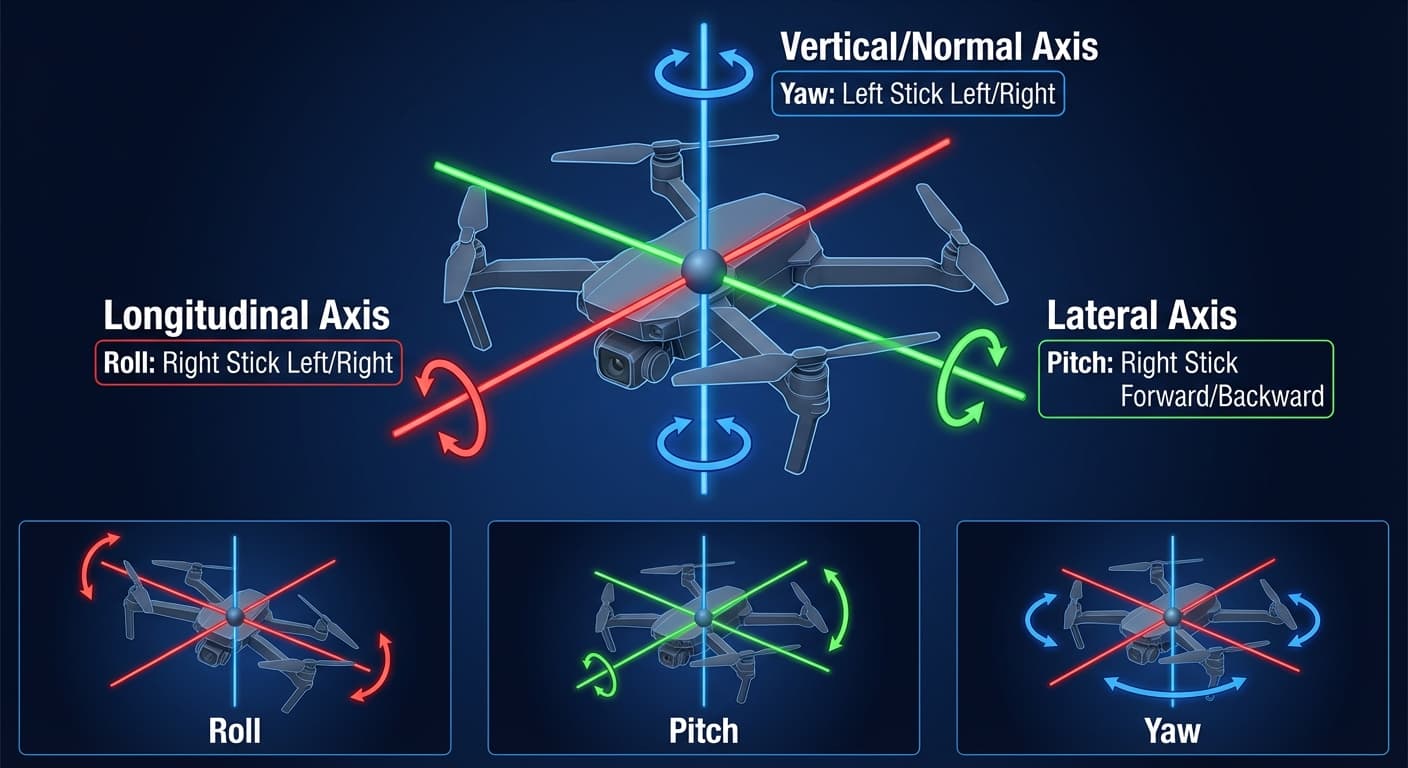
Every movement is around an axis
Pitch is movement around the lateral axis, roll is movement around the longitudinal axis and yaw is movement around the vertical axis.
Remote pilots do not need to become aerodynamic engineers, but they do need to connect stick input, aircraft attitude, power and flight path.
Power changes vertical and horizontal performance
Increasing power may increase climb, speed or both depending on the aircraft type and attitude. Reducing power may increase descent or reduce speed.
Angle of climb describes steepness over the ground. Rate of climb describes vertical speed. Wind can change the angle over the ground without changing the aircraft's actual vertical performance.
Skid, slip and trim are control quality topics
Skid and slip describe unbalanced flight. Trim controls reduce the force or input needed to hold an attitude. Even when automation hides these effects, the pilot should recognise poor control behaviour.
Practice Questions
Which axis is associated with yaw?
- Vertical axis
- Longitudinal axis
- Lateral axis
- Magnetic axis
Answer: Vertical axis
Yaw is rotation left or right around the aircraft's vertical axis.
Next step after study
Complete your Remote Pilot Licence training
The free study guide is a strong theory foundation. To actually be issued with a RePL, students still complete approved training, practical flying and assessment with a certified provider.