
RBKM - Multirotor
Propulsion, Telemetry and Failsafe Checks
Connect propellers, motors, ESCs, telemetry warnings and failsafe settings into practical pre-flight and in-flight decisions.
Lesson references
- Last reviewed
- 2026-05-19
- Lesson references
- RePL Study Guide pp. 166-183; Part 101 MOS C10 pp. 111-113; CASA AC 101-03 v2.0 Appendix C checked 2026-05-19.
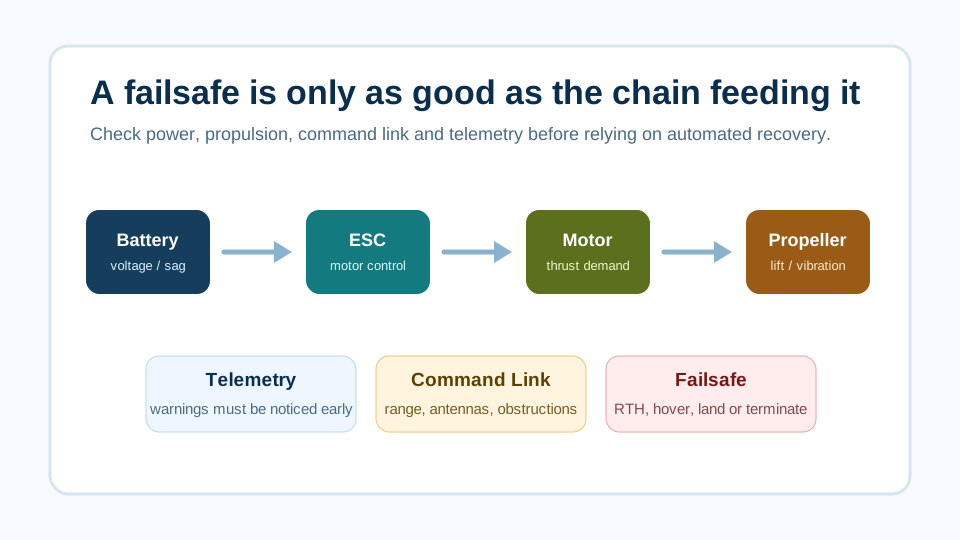
Propulsion is a chain, not a single component
A multirotor produces lift through a connected chain: battery, power distribution, ESCs, motors, propellers, flight controller commands and the aircraft structure holding everything in alignment.
A problem anywhere in that chain can look like poor climb, vibration, unexpected yaw, unstable hover, unusual noise, motor warning, hot components or a sudden loss of control margin.
Propellers are small aerofoils under high load
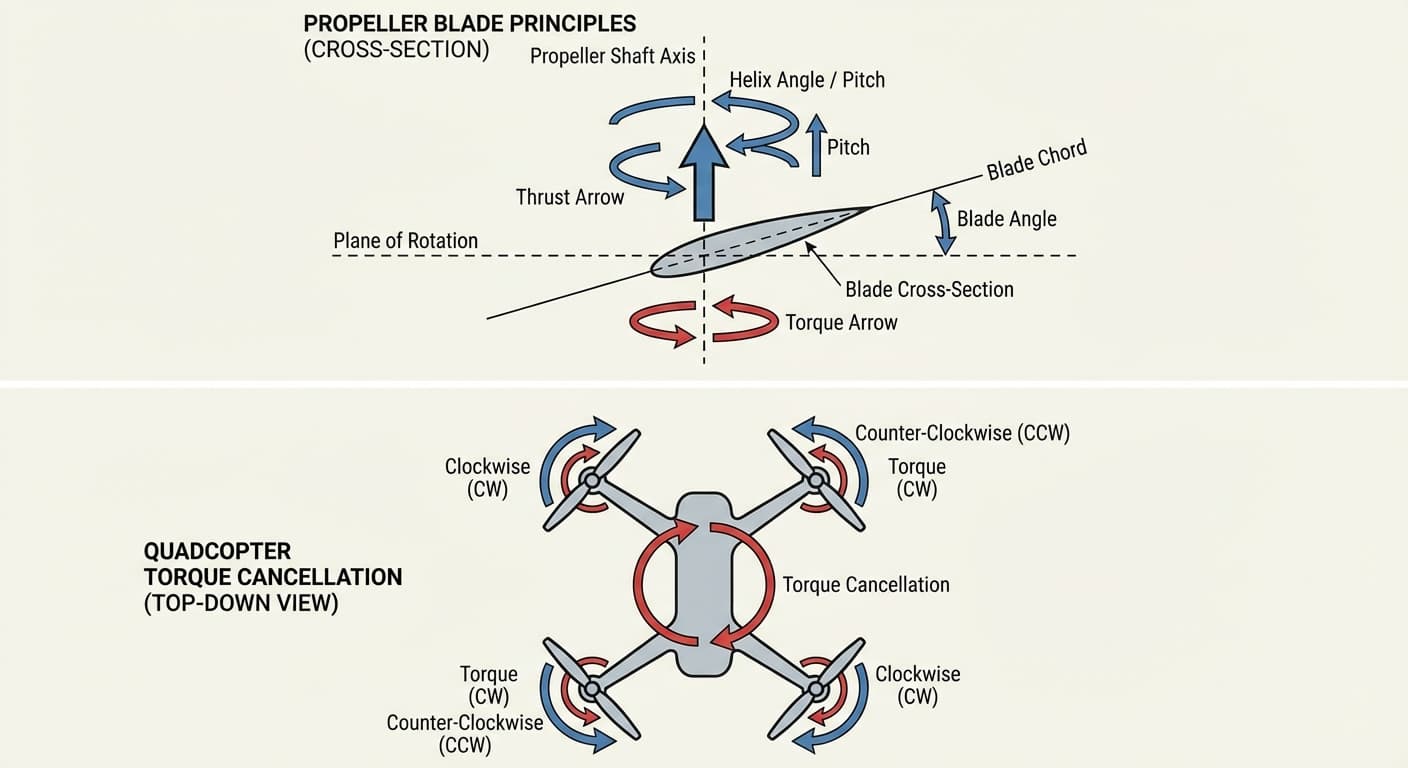
Propellers create thrust by accelerating air. Their condition matters: chips, cracks, deformation, incorrect fitment, wrong rotation, loose hubs or contamination can create vibration and reduce thrust.
The propeller check is not cosmetic. A damaged or incorrectly installed propeller can overload motors and ESCs, confuse sensors through vibration and leave the aircraft with too little control margin when it matters.
Motors and ESCs turn battery energy into control authority
The ESC controls motor speed in response to the flight controller. The motor and propeller then produce the thrust needed for lift, attitude control and recovery.
High current, poor cooling, damaged cables, loose connectors, worn bearings, contamination, water ingress or overheating can reduce reliability. CASA's model-aircraft guidance also notes that current flows in battery-controller-motor setups can be extremely high and that cables and connectors need to be in good order.
- Check motor security, free rotation, abnormal noise and heat.
- Check ESC warnings, wiring, connectors and signs of overheating.
- Do not ignore vibration, repeated motor errors or unexplained yaw.
Telemetry warnings are early decision points
Telemetry gives the remote pilot battery state, link quality, GPS health, mode state, height, distance, warnings and aircraft behaviour cues. It is only useful if the pilot notices it early and responds conservatively.
A warning is not a suggestion to press on until the job is finished. Battery sag, weak link, compass disagreement, motor load, excessive wind or GPS health warnings should push the crew toward simpler tasks, better link geometry or recovery.
Return-to-home is not a magic button
Return-to-home depends on aircraft configuration, home point accuracy, GNSS quality, height setting, obstacle environment, wind, battery state and command-link logic. If any of those assumptions are wrong, the automated recovery may create a new problem.
Before launch, the crew should confirm what the aircraft will do for loss of command link, low battery, critical battery, GNSS degradation, geofence boundary and manual RTH activation.
Failsafe choices must match the site
Hover, land, return-to-home, hold, terminate and parachute options have different consequences. The best option depends on people, obstacles, water, roads, controlled airspace, wind, terrain, structures and the aircraft's actual position.
A suitable failsafe in an open paddock may be unsuitable beside a road, under a bridge, near a crowd or inside a constrained industrial site.
- Check home point and RTH height before take-off.
- Confirm geofence and maximum-distance settings match the job.
- Brief what the crew will do if automation behaves differently from expectation.
Pre-flight checks should include a controlled behaviour check
A safe launch is not complete when the aircraft leaves the ground. A brief controlled hover and response check can reveal vibration, drift, poor position hold, sensor disagreement, abnormal noise or unexpected control response before the aircraft moves away.
If the aircraft does not feel or look right, land and inspect. The cheapest time to solve a propulsion or telemetry problem is while the aircraft is still close and controllable.
Practice Questions
Why is a damaged propeller more than a cosmetic issue?
- It can create vibration, reduce thrust and stress motors or ESCs.
- It only changes the aircraft colour.
- It improves telemetry quality.
- It makes GNSS more accurate.
Answer: It can create vibration, reduce thrust and stress motors or ESCs.
Propeller damage can affect lift, vibration, component load and aircraft controllability.
What should repeated telemetry warnings usually trigger?
- A conservative decision such as recovery, investigation or simplifying the task.
- Continuing farther from the recovery area.
- Turning off all warnings.
- Assuming the warning is always false.
Answer: A conservative decision such as recovery, investigation or simplifying the task.
Telemetry warnings are early signals that the aircraft may be losing operating margin.
Why must return-to-home settings be checked before launch?
- RTH depends on home point, height, GNSS, battery, wind and obstacle assumptions.
- RTH always works perfectly in every site.
- RTH replaces the need for a landing area.
- RTH makes propeller checks unnecessary.
Answer: RTH depends on home point, height, GNSS, battery, wind and obstacle assumptions.
Automated recovery is only safe if the assumptions behind it suit the site and aircraft state.
What is the value of a controlled hover check after take-off?
- It can reveal abnormal vibration, drift, noise or control response while the aircraft is still close.
- It replaces all pre-flight inspection.
- It proves the battery can never fail.
- It removes the need to monitor telemetry.
Answer: It can reveal abnormal vibration, drift, noise or control response while the aircraft is still close.
Post-launch checks catch problems while recovery is still simple.
Next step after study
Complete your Remote Pilot Licence training
The free study guide is a strong theory foundation. To actually be issued with a RePL, students still complete approved training, practical flying and assessment with a certified provider.