
AROC - Aeronautical Radio
Radio Fundamentals, Responsibilities and Phraseology
Understand when an AROC is needed, how aviation radio is used, and how phraseology, readability, numbers and time keep calls clear.
Lesson references
- Last reviewed
- 2026-05-19
- Lesson references
- RePL Study Guide pp. 278-306; CASA radio operators guidance checked 2026-05-19; CASA AC 101-01 v6.1.
AROC is authority to use the aviation radio
An Aeronautical Radio Operator Certificate is required for a person who needs to communicate on an aviation air-band radio frequency and is not already qualified another way. CASA's current radio-operator guidance specifically includes remote pilot licence holders among the people who may need an AROC.
For a remote pilot, the important study habit is to separate flying authority from radio authority. A RePL may authorise remote-pilot privileges, but the operation may also require an AROC, an approved procedure, the correct frequency and disciplined radio use.
- Check whether the operation needs radio communication before the job starts.
- Use current CASA, ERSA, chart and operator sources for frequency and procedure checks.
- Do not treat radio use as optional if the operation or airspace requires it.
Frequency choice comes from current operational sources
A remote pilot should not guess a frequency from memory. Frequencies, CTAF details, controlled-airspace requirements and local procedures must be checked from current operational sources and the operator's approved procedures.
The radio plan should be briefed in plain terms: which frequency is used, who monitors it, who transmits, what calls are expected, what backup communication exists and what happens if the radio becomes unusable.
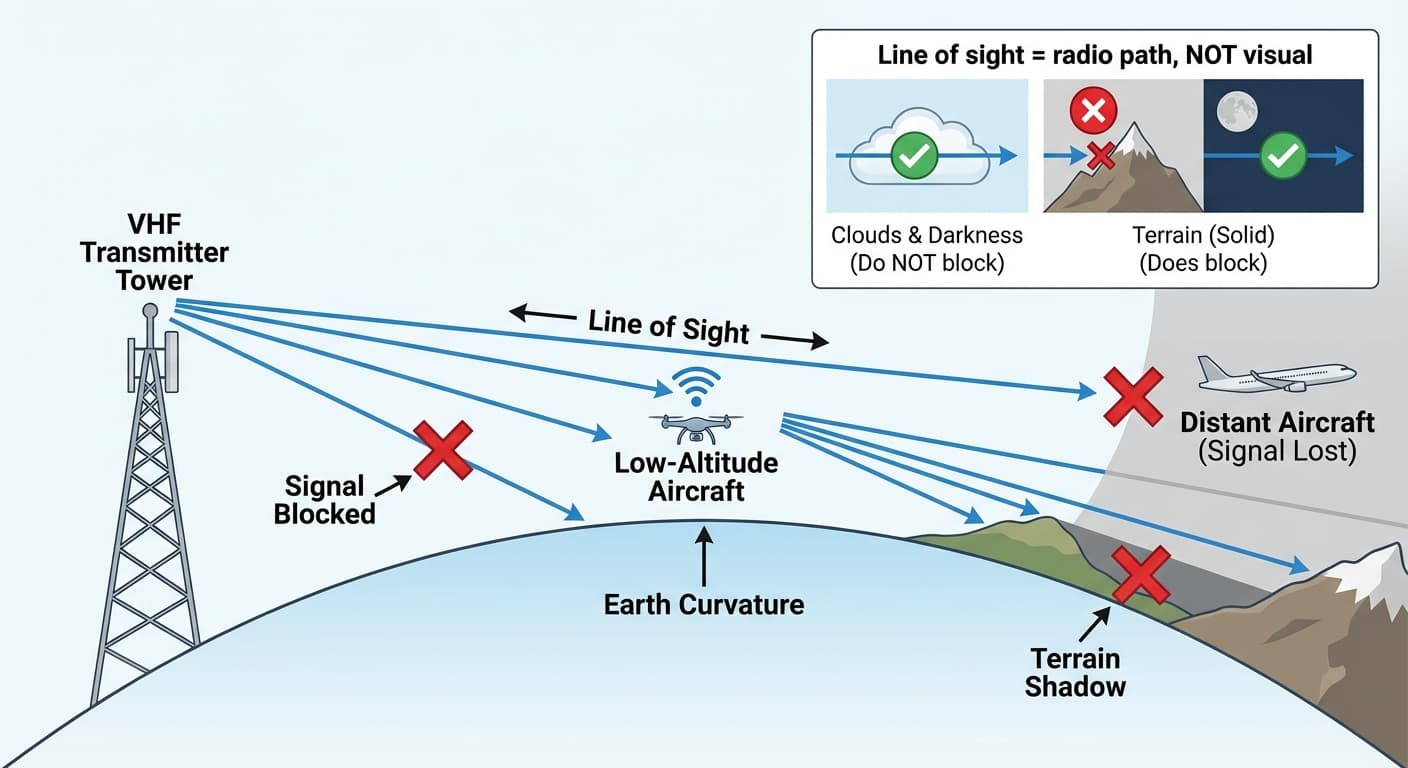
VHF radio is mostly line of sight
VHF aviation radio usually behaves like a line-of-sight system. Terrain, buildings, aircraft height, antenna orientation, handheld-radio position and battery state can all affect whether another station can hear the call.
That is why a radio check and equipment check belong in the job preparation, not after the aircraft is airborne and workload is already high.
Listen first, then transmit a useful call
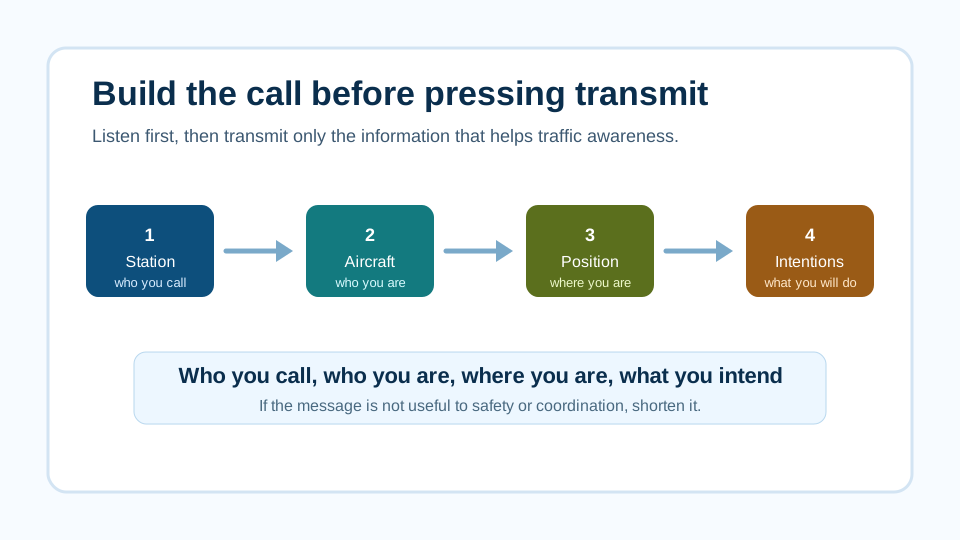
Good radio discipline begins with listening. The pilot should build a mental traffic picture before transmitting and avoid blocking another station.
A useful aviation call is short and structured. It normally tells listeners who is being called, who is transmitting, where the aircraft or operation is, and what the pilot intends to do.
Phraseology reduces interpretation work
Standard phraseology exists because aviation radio is often noisy, busy and time-sensitive. It lets different pilots, controllers and operators understand each other without inventing wording on the spot.
For study, focus on intent rather than theatre. The goal is not to sound dramatic. The goal is to be accurate, brief and predictable so other airspace users can act on the information.
- Use the phonetic alphabet for letters, callsigns and spelling when clarity matters.
- Speak numbers and times slowly enough to be written down.
- Avoid jokes, slang and long explanations on an aviation frequency.
Readability is a safety signal
The readability scale gives a quick way to report how well a transmission is being received. If a critical call is unreadable or only partly readable, the safe response is to ask again or use an approved alternate communication path.
Never pretend a message was understood. Guessing an instruction, frequency, position or emergency detail can create a larger problem than asking for clarification.
Numbers and time need extra care
Numbers carry operational meaning: height, distance, runway direction, frequency, time, position and callsign details. They should be spoken clearly and checked back when required by procedure.
Use UTC and date-time group habits where the operation requires them. If local time is used for an internal job note, make sure the team knows exactly which time reference applies.
Practice Questions
What does an AROC broadly authorise?
- Use of an aviation air-band radio frequency by a person who needs that qualification.
- Automatic permission to fly in all controlled airspace.
- Approval to ignore the operator's radio procedures.
- A replacement for a RePL.
Answer: Use of an aviation air-band radio frequency by a person who needs that qualification.
AROC is radio authority. It does not replace pilot, operator or airspace approvals.
Where should a remote pilot confirm the correct frequency for a job?
- Current operational sources and the operator's approved procedures.
- A frequency remembered from an old job without checking.
- A random online comment.
- Only the aircraft battery label.
Answer: Current operational sources and the operator's approved procedures.
Frequency and procedure information must be current and relevant to the operation.
What should happen before transmitting on an aviation frequency?
- Listen first and prepare a concise, useful call.
- Transmit immediately without checking for other traffic.
- Use slang so the call sounds relaxed.
- Hold the transmit button while deciding what to say.
Answer: Listen first and prepare a concise, useful call.
Listening first helps avoid blocking other calls and improves traffic awareness.
Why is standard phraseology useful?
- It makes calls predictable and reduces misunderstanding.
- It makes every transmission longer.
- It replaces the need for lookout.
- It means readability no longer matters.
Answer: It makes calls predictable and reduces misunderstanding.
Predictable wording helps listeners understand calls under workload, noise or time pressure.
Next step after study
Complete your Remote Pilot Licence training
The free study guide is a strong theory foundation. To actually be issued with a RePL, students still complete approved training, practical flying and assessment with a certified provider.