
RKOP - Operations
Operational Risk, Logs and Emergencies
Turn a planned task into a controlled operation through risk assessment, records, serviceability checks and emergency thinking.
Lesson references
- Last reviewed
- 2026-05-18
- Lesson references
- RePL Study Guide pp. 44-65 and 267-270; Part 101 MOS C10 pp. 103-105.
A job is not ready just because the aircraft is ready
Operational readiness includes crew briefing, bystander control, aircraft serviceability, payload implications, technical logs, emergency options and the decision path for approvals.
The latest C10 MOS includes tethered operations in RKOP, so this web guide treats tethering as an operational topic to be planned, controlled and reviewed rather than as a shortcut around normal discipline.
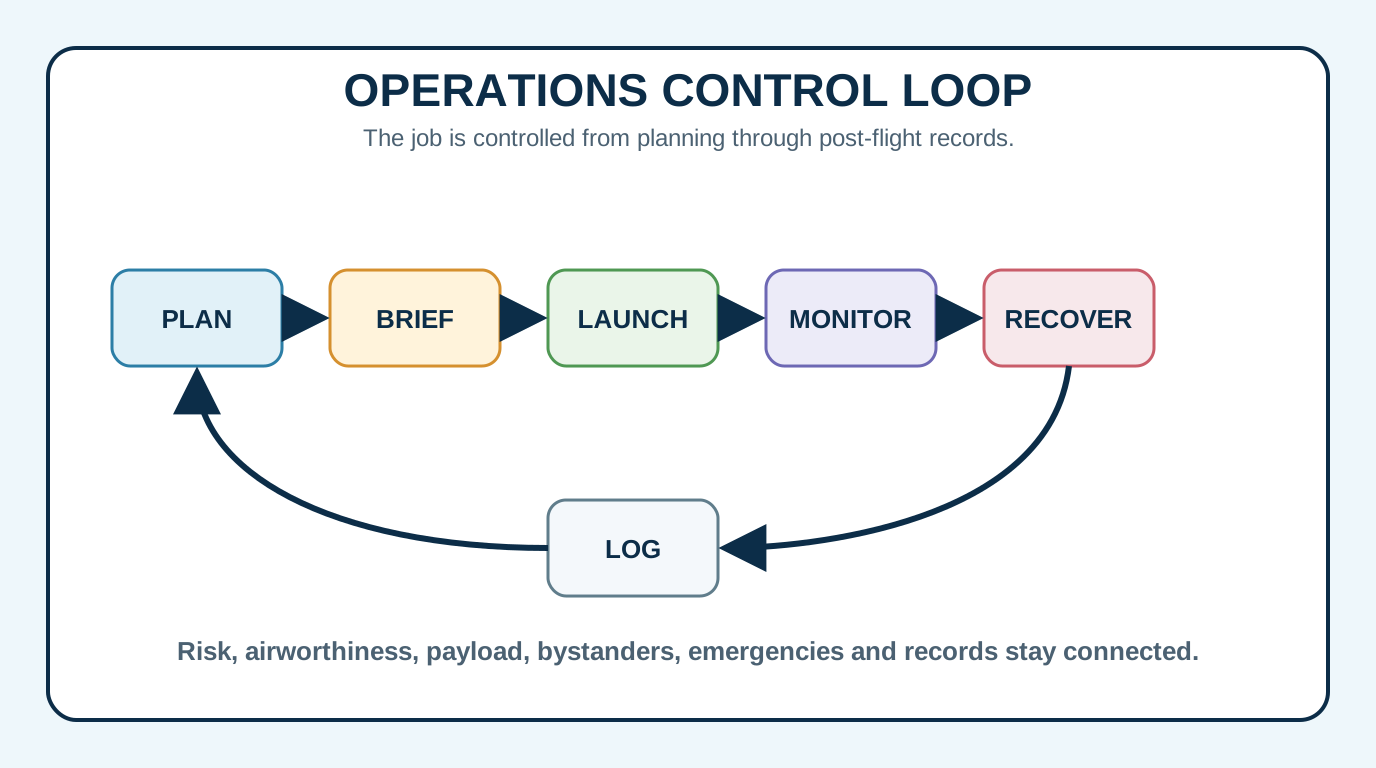
General operations begin on the ground
Starting motors, ground running, launch layout, bystander control and crew briefing are all operational controls. The aircraft may be ready to fly, but the site may not be ready for flight.
The remote pilot must also work inside the operator's documented practices and procedures, not just the manufacturer's app workflow.
- Brief roles, boundaries, stop words, emergency actions and the landing area.
- Control bystanders before propellers turn.
- Think about noise, wildlife and site impact before and after the operation.
Risk assessment is a working tool
A job safety assessment should identify hazards, assess the operational risk, choose controls and leave a decision trail. It should not be paperwork written after the real decision has already been made.
Strategic risk assessment happens during planning. Tactical risk assessment continues at the site and during flight as weather, people, aircraft state and airspace conditions change.
- Hazard: what can cause harm or loss of control?
- Risk: how likely is it and how serious would it be?
- Control: what action reduces likelihood, consequence or exposure?
- Decision: go, modify, delay or stop.
Airworthiness is a pilot responsibility too
The remote pilot is not expected to rebuild the aircraft before every job, but they are expected to determine whether the RPAS is serviceable for the specific operation.
Technical logs, defect reporting, maintenance status, firmware state, propeller condition, battery history and payload fit all feed that decision.
- Do not launch with unresolved defects that affect safe operation.
- Use the technical log to track problems instead of relying on memory.
- Report unserviceability through the operator's procedure.
Payloads change the aircraft and the job
Role equipment and sensors can change mass, balance, endurance, electrical demand, drag, privacy considerations and the way the aircraft must be flown.
A camera, thermal sensor, LiDAR, spray tank, winch or tether is not just attached equipment. It changes the operational risk picture and should be part of the briefing.
Accidents and incidents must be reported through the right channel
The study guide can explain the difference between ordinary defects, incidents and accidents, but the actual reporting decision must follow current law, operator procedures and any applicable transport safety reporting requirements.
The conservative habit is to preserve information early: time, location, aircraft, crew, sequence of events, injuries, damage, battery state, logs and any downloaded aircraft data.
Emergency actions must be chosen before launch
Return-to-home, immediate landing, holding points, parachutes and flight termination are not interchangeable. The right response depends on airspace, people, terrain, aircraft state and what the failure actually is.
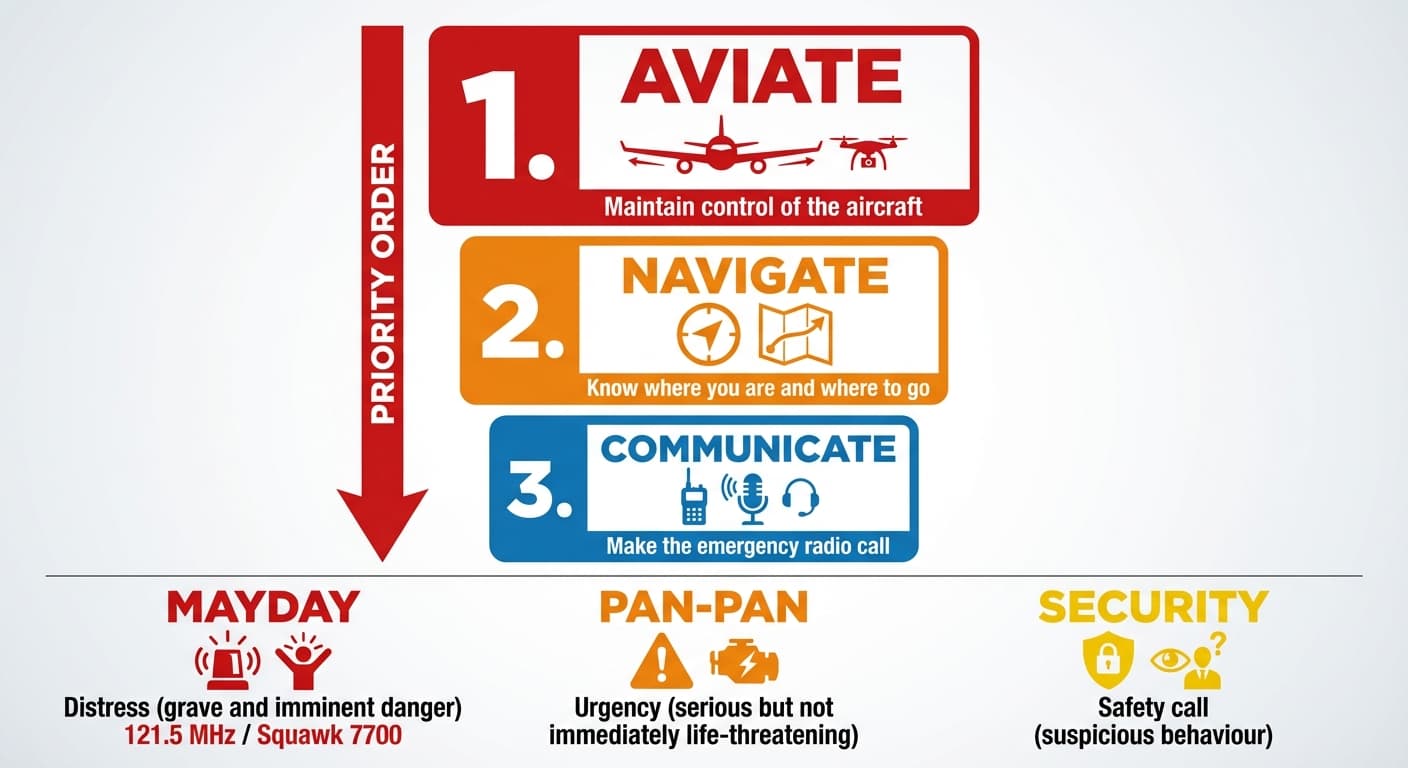
- Motor failure immediately after launch needs a different response from a slow battery warning.
- Lost link should already have a known failsafe action and recovery area.
- Bird attack, flyaway, fire, crash, injured person and loss of navigation all need pre-briefed decision paths.
Aerodrome and above-400-ft operations need extra discipline
Operations near aerodromes and operations above 400 ft AGL are not ordinary field jobs with a bigger number. They need careful source checking, approval pathways, traffic awareness and a clear understanding of what the operator is authorised to do.
If the legal or procedural basis is uncertain, the job should pause until the chief remote pilot or nominated aviation reviewer resolves it.
Tethered operations are still operations
A tether can reduce some risks and introduce others. It may affect launch setup, snag hazards, bystander control, electrical safety, emergency response, aircraft performance and recovery options.
Treat tethering as a specific operating method with its own checks and limitations, not as a casual shortcut.
Practice Questions
Why should emergency actions be briefed before launch?
- Because time pressure during a failure makes improvisation risky.
- Because failures only happen after landing.
- Because the RPA will always choose the safest option automatically.
- Because logs are optional for commercial work.
Answer: Because time pressure during a failure makes improvisation risky.
Pre-briefed actions reduce delay and confusion when control link, motor, battery or airspace problems occur.
What is the purpose of a job safety assessment for an RPA operation?
- To identify hazards, assess risk, choose controls and record the decision path.
- To replace all pilot judgement during the flight.
- To make bystander control unnecessary.
- To guarantee weather will remain unchanged.
Answer: To identify hazards, assess risk, choose controls and record the decision path.
A JSA is a practical risk-management tool that supports planning, briefing and review.
A payload is added to an aircraft that was serviceable yesterday. What should the pilot consider?
- Mass, balance, endurance, electrical demand and task risk may have changed.
- Payloads never affect an RPA.
- Only the camera operator needs to know.
- The technical log is no longer relevant.
Answer: Mass, balance, endurance, electrical demand and task risk may have changed.
Role equipment and sensors can change aircraft performance and operational risk.
Why should a tethered operation still be formally planned?
- A tether changes hazards, setup, bystander control and emergency recovery options.
- A tether removes every aviation requirement.
- Tethered aircraft cannot injure people.
- Tethering means no crew briefing is needed.
Answer: A tether changes hazards, setup, bystander control and emergency recovery options.
Tethering is an operating method with specific risks and controls.
Next step after study
Complete your Remote Pilot Licence training
The free study guide is a strong theory foundation. To actually be issued with a RePL, students still complete approved training, practical flying and assessment with a certified provider.