
RACP - Airspace and Charts
Circuit Patterns, Aerodrome Traffic and CTAF Awareness
Picture aerodrome traffic before launch: circuit legs, approach and departure paths, CTAF awareness, ERSA cues and practical RPA stop triggers.
Lesson references
- Last reviewed
- 2026-05-21
- Lesson references
- RePL Study Guide pp. 92-98 and 278-313; Part 101 MOS C10 Schedule 4 Unit 2.
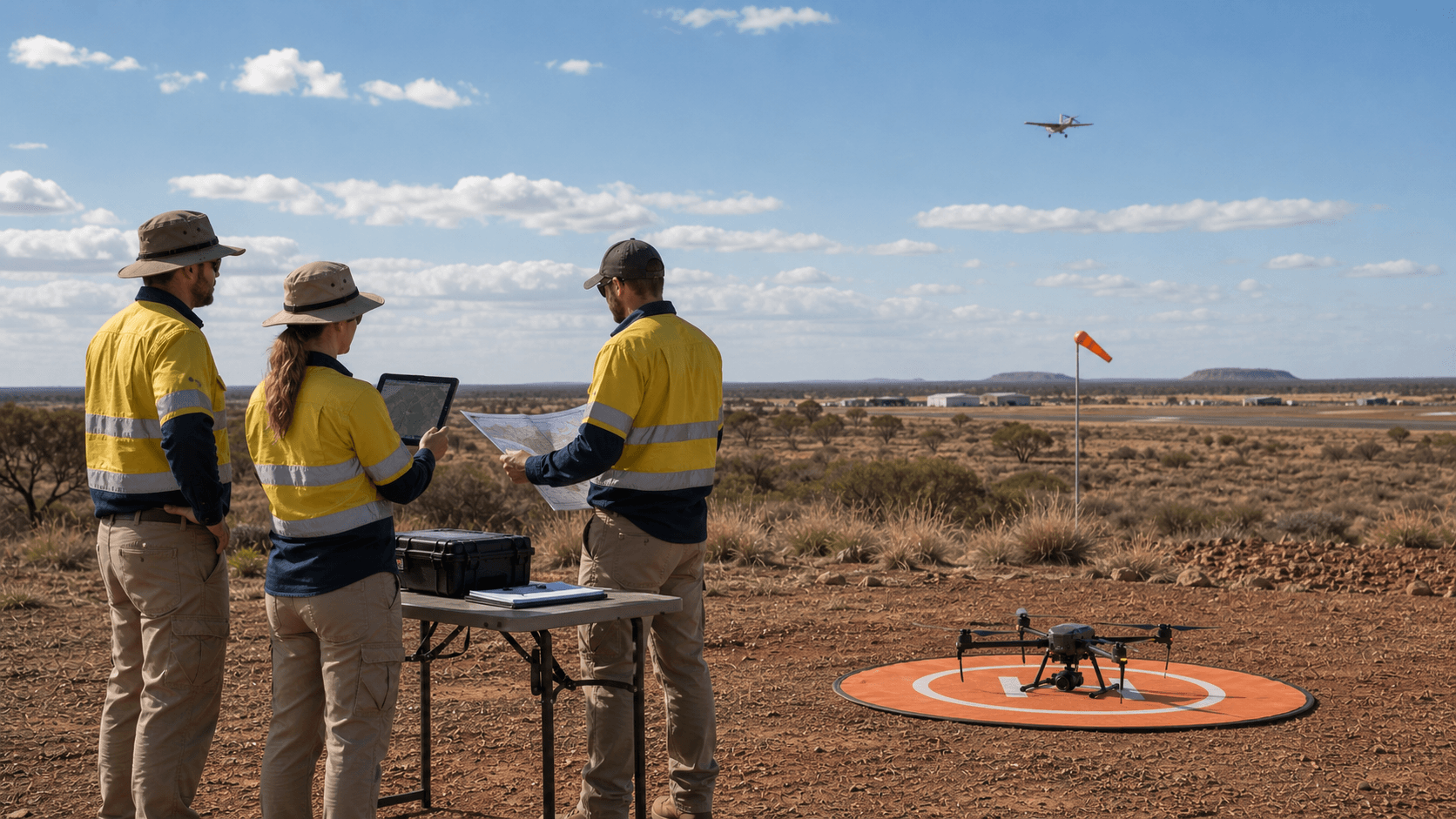
The circuit is a mental traffic map
A circuit is the normal traffic pattern aircraft use around an aerodrome for take-off, landing and sequencing. A remote pilot does not need to fly that pattern, but they do need to picture it before operating nearby.
The practical question is simple: could a crewed aircraft be climbing, descending, joining, turning or tracking near the RPA site while the drone is airborne?
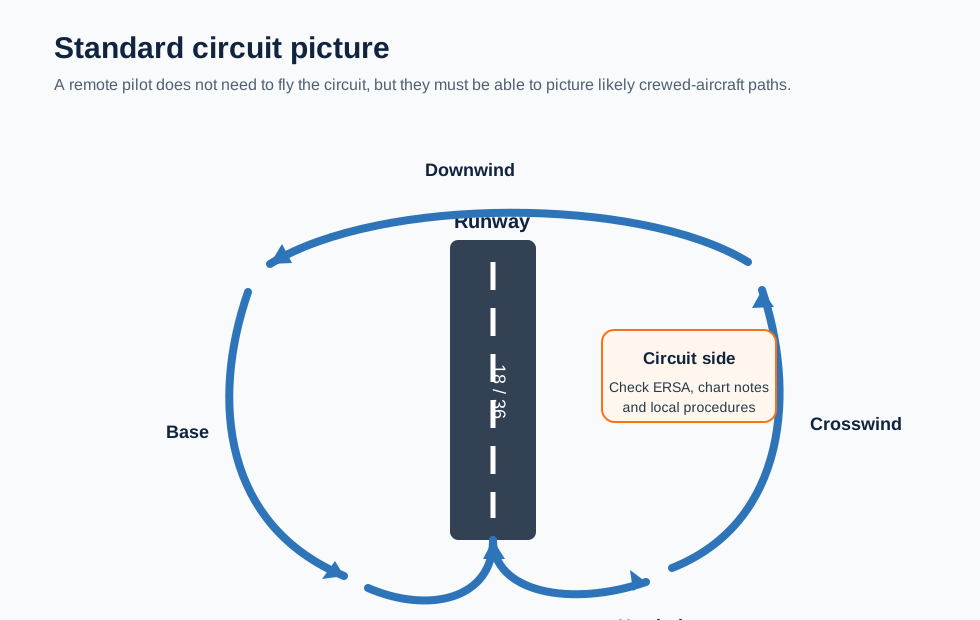
- Final and departure paths are high-priority conflict areas.
- Downwind, base and crosswind legs help explain where training traffic may appear.
- Circuit direction, runway in use and local procedures must be checked from current sources.
Runway direction helps you picture traffic
Runway numbers are magnetic orientation cues. A runway marked 18/36 points roughly north-south; 09/27 points roughly east-west. That lets the crew visualise likely approach and departure directions before aircraft are seen or heard.
Runway orientation is not permission to operate. It is a situational-awareness tool that helps the remote pilot brief observers, set boundaries and recognise when the planned area may sit under a traffic path.
- Ask which runway is likely in use based on wind and published information.
- Brief observers on where aircraft may appear first.
- Consider helicopters and non-standard joins, not just fixed-wing circuit traffic.
- Treat uncertainty about traffic flow as a reason to pause, not as a reason to launch.
The worksite may be outside the fence but inside the traffic picture
An RPA job does not need to be on an aerodrome to affect aerodrome traffic. Approach paths, departure paths, circuit legs, helicopter routes, training areas and local transit paths can all extend beyond the aerodrome boundary.
This is where map distance can mislead. A site can be outside a simple radius but still close to a real traffic path, especially near runway extended centreline, circuit area, low-level helicopter activity or published cautions.
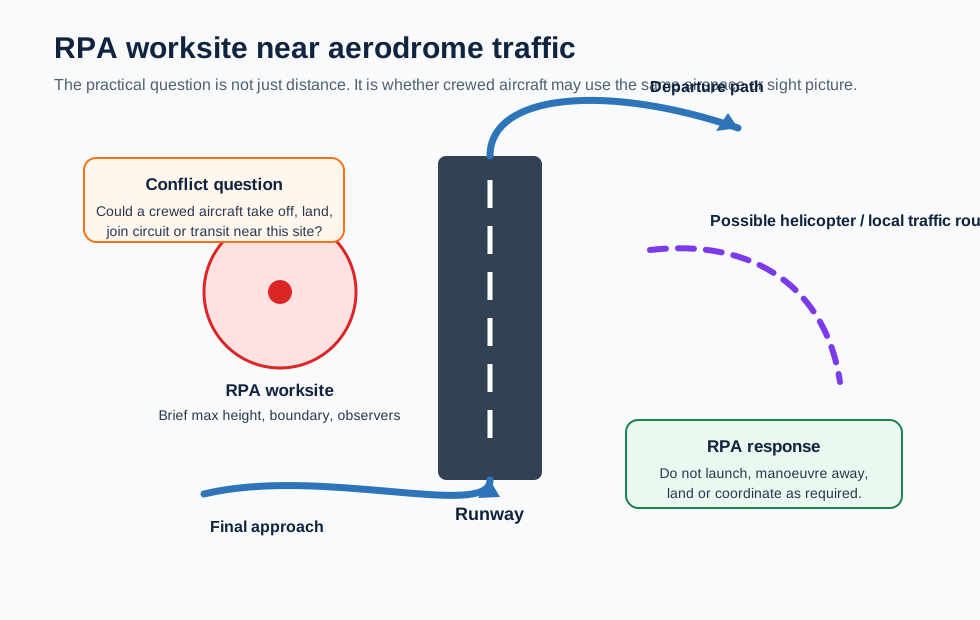
- Do not operate in a way that creates a collision hazard with aircraft.
- Land or hold clear early if a crewed aircraft path becomes uncertain.
- Use observers where the pilot cannot maintain a reliable traffic picture alone.
ERSA, CTAF and chart notes turn symbols into action
ERSA can provide aerodrome facts that matter to an RPA crew: runway directions, frequencies, remarks, cautions, operating hours, lighting, procedures and local notes. Charts show the structure; ERSA and NOTAMs explain the operational details.
CTAF awareness is about shared traffic awareness at non-controlled aerodromes. If the operation requires radio communication, the crew needs the correct qualification and equipment. Even where transmitting is not required, the remote pilot still needs a plan for hearing, seeing and responding to traffic.
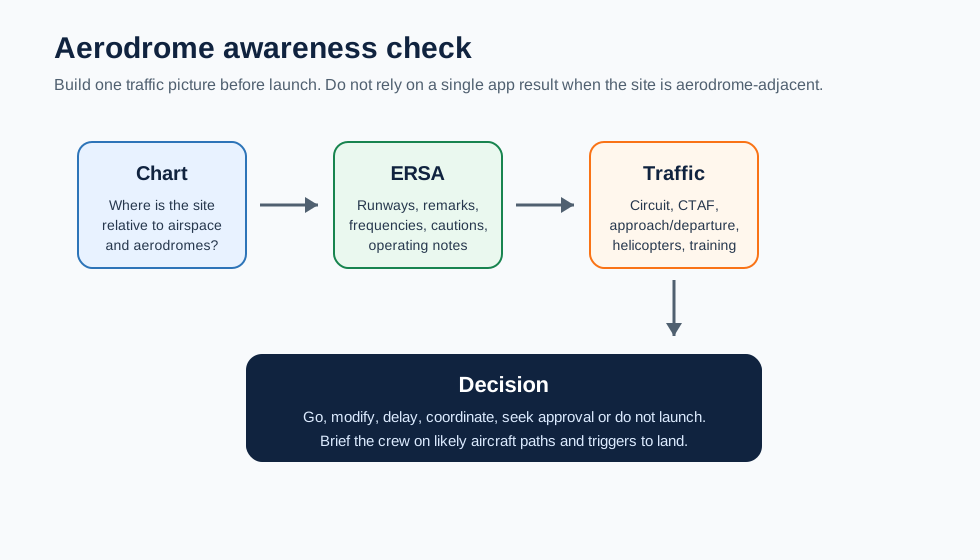
- Check current aerodrome information and NOTAMs close to flight time.
- Confirm the CTAF or frequency context from current sources, not memory.
- Brief radio assumptions clearly: monitor only, transmit, or no radio required under the approved procedure.
- Do not publish or use example calls operationally until reviewed by an aviation SME.
Controlled and non-controlled aerodromes are different problems
Near controlled aerodromes, the key question is authorisation and controlled-airspace interaction. Around non-controlled aerodromes, the key question is often traffic awareness, circuit conflict and whether the drone operation must give way, land, coordinate or stay clear.
CASA guidance, operator approvals and current aeronautical information must decide the exact pathway. For study, the durable habit is to recognise the trigger early and stop pretending an aerodrome-adjacent job is just a normal paddock job.
- Controlled aerodrome: check approval, airspace, movement area and approach/departure path restrictions.
- Non-controlled aerodrome: check circuit, CTAF, traffic, runway direction and published cautions.
- Any aerodrome: check NOTAMs and current operator procedures before launch.
Set clear traffic triggers before launch
A remote pilot should not wait until a crewed aircraft is close before deciding what to do. The crew brief should include triggers that produce a simple response: hold, land, remain below a lower height, move inside a tighter boundary, or do not launch.
This is study guidance, not legal advice. Verify current CASA rules, Airservices information, ERSA, NOTAMs, operator approvals and aviation reviewer advice before using any aerodrome-adjacent procedure.
- Aircraft heard or seen joining circuit: hold or land according to the brief.
- Aircraft on final or departure path near the worksite: land or remain clear early.
- Traffic picture uncertain: pause and resolve before launch or continue only if the procedure allows it.
- Radio or observer workload too high: simplify the task or stop.
Practice Questions
Why should a remote pilot understand the circuit pattern near an aerodrome?
- It helps the crew picture likely crewed-aircraft paths before launch.
- It allows the RPA to join the circuit without approval.
- It replaces the need to check ERSA or NOTAMs.
- It proves the aerodrome is inactive.
Answer: It helps the crew picture likely crewed-aircraft paths before launch.
Circuit awareness helps the RPA crew anticipate where aircraft may climb, descend, join or turn.
A worksite is outside the aerodrome fence but near the runway extended centreline. What is the key concern?
- Crewed aircraft may be using the approach or departure path near the RPA site.
- The fence automatically removes all traffic risk.
- Only battery temperature matters.
- The RPA can ignore aircraft if it remains below 400 ft.
Answer: Crewed aircraft may be using the approach or departure path near the RPA site.
Conflict awareness depends on real traffic paths, not only the physical aerodrome boundary.
What is the safest way to use CTAF information in an RPA plan?
- Check the current frequency/procedure and brief how the crew will monitor, transmit or otherwise manage traffic awareness.
- Guess the frequency from memory.
- Assume CTAF means no aircraft will be nearby.
- Use CTAF as a substitute for visual line of sight.
Answer: Check the current frequency/procedure and brief how the crew will monitor, transmit or otherwise manage traffic awareness.
CTAF supports shared traffic awareness, but the crew must use current information and the correct qualifications/procedure.
Which condition should trigger a hold, landing or reassessment near an aerodrome?
- The crew is uncertain where nearby traffic is or what runway/circuit activity is occurring.
- The map looks visually simple.
- The customer wants the job completed quickly.
- The aircraft camera is recording normally.
Answer: The crew is uncertain where nearby traffic is or what runway/circuit activity is occurring.
Uncertainty about crewed-aircraft traffic is a safety trigger. The pilot should pause, land or resolve the traffic picture.
Next step after study
Complete your Remote Pilot Licence training
The free study guide is a strong theory foundation. To actually be issued with a RePL, students still complete approved training, practical flying and assessment with a certified provider.