
RACP - Airspace and Charts
Airspace Classes, Controlled Aerodromes and CTAF
Build the airspace picture around class, aerodrome type, controlled airspace, CTAF, VLOS, altitude and approval triggers.
Lesson references
- Last reviewed
- 2026-05-18
- Lesson references
- RePL Study Guide pp. 66-82 and 92-98; Part 101 MOS C10 pp. 94-95; CASA flight approvals and permissions guidance checked 2026-05-18.
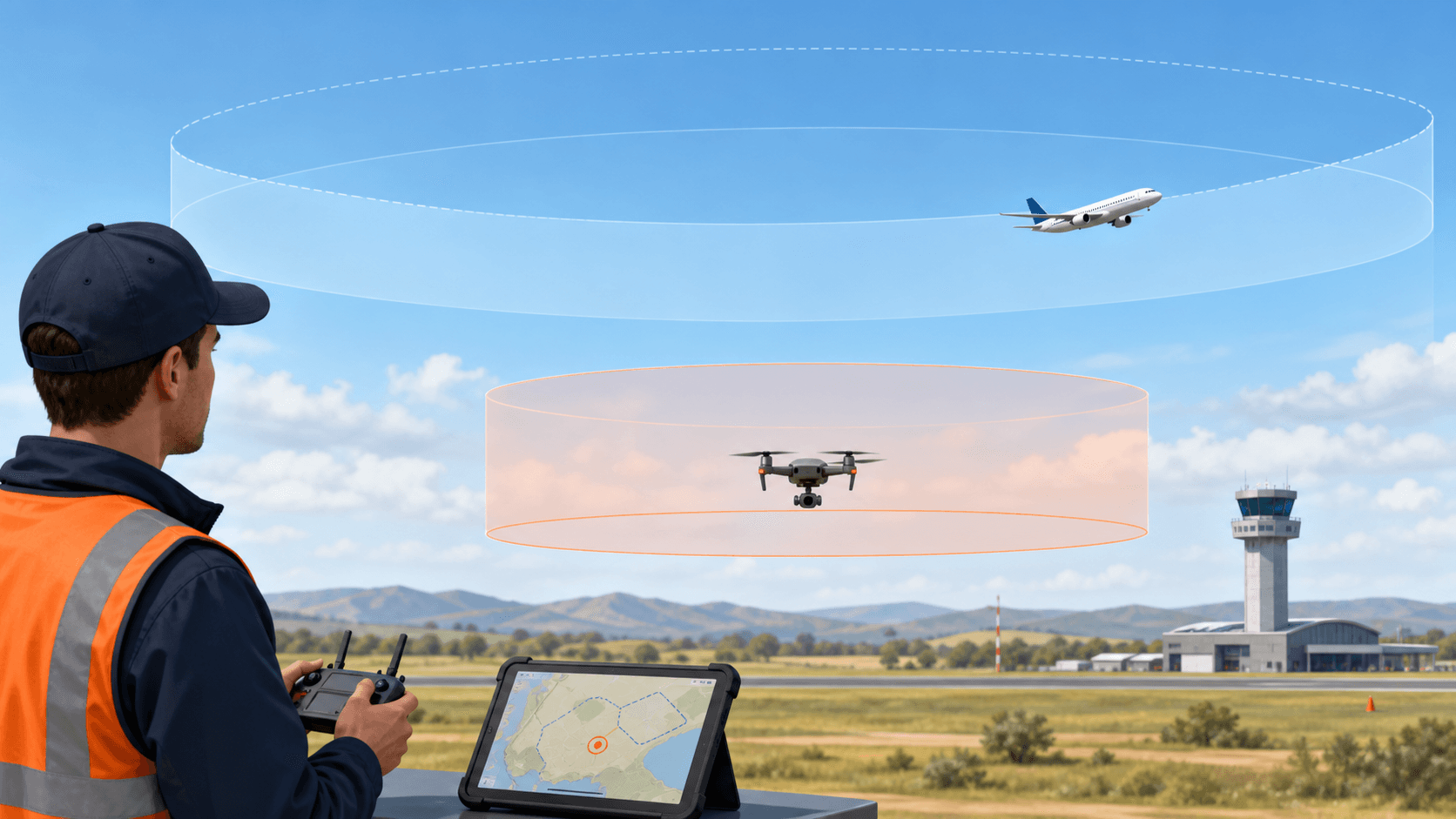
Airspace class describes the traffic environment
Airspace class is the first clue to what kind of aviation environment surrounds the operating site. Controlled airspace is managed by air traffic services. Non-controlled airspace still has rules, traffic patterns, radio frequencies and other aircraft.
For RPA planning, the point is not to memorise every service detail from crewed aviation. The point is to recognise when the operation has moved from a simple open-area job into an airspace decision that needs a chart, current publication, approval check or radio consideration.
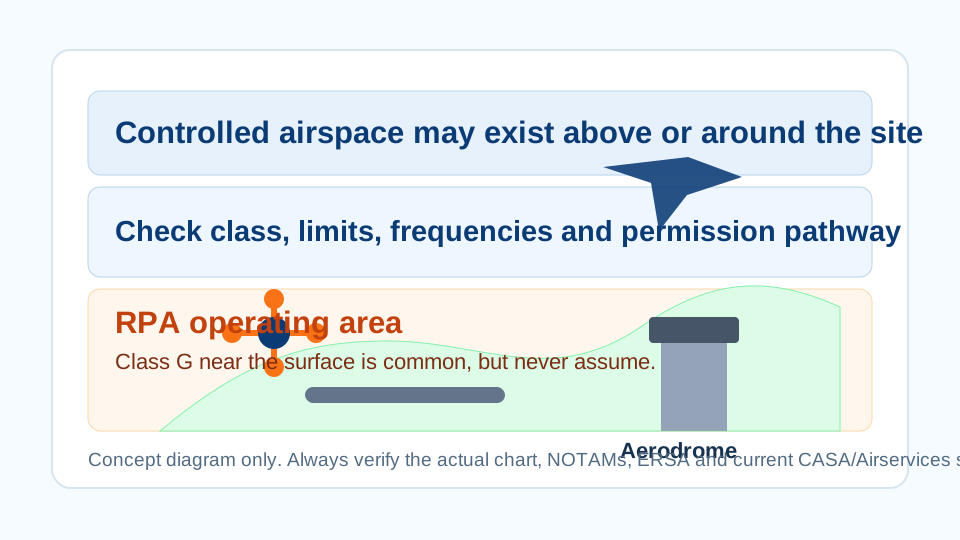
- Class A is high-level controlled airspace and is not a normal RPA operating environment.
- Class C and Class D commonly matter around controlled aerodromes and control zones.
- Class E can sit above lower-level airspace and still affect the wider airspace picture.
- Class G is non-controlled airspace, not rule-free airspace.
Controlled aerodromes change the approval question
A controlled aerodrome generally has an operating air traffic control tower. Around those aerodromes, RPA operations may be affected by control zones, approach and departure paths, movement areas, height limits, airspace authorisations and operator-specific approvals.
CASA's current public guidance identifies several situations that require authorisation, including operations above 120 m or 400 ft AGL, operations within 5.5 km or 3 NM of a controlled aerodrome, operations over a controlled aerodrome movement area, and operations in the approach or departure path of a controlled aerodrome.
That wording must be checked against the current CASA page and any operator approval before flight. In the study guide, the durable lesson is the decision habit: do not treat controlled aerodrome proximity as just another map symbol.
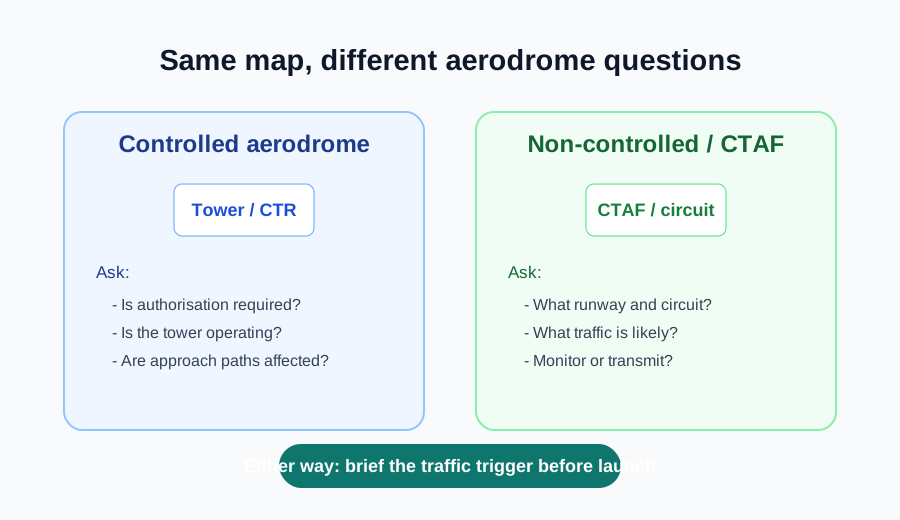
- Identify whether the aerodrome is controlled and whether the tower is operating.
- Check the control zone, approach/departure paths and movement area.
- Confirm whether the ReOC, chief remote pilot and individual remote pilot have the required approval pathway.
- Record the decision source, date, time and any approval reference in the job pack.
CTAF does not mean casual
A non-controlled aerodrome is normally in Class G airspace. It may use a Common Traffic Advisory Frequency so aircraft can broadcast position and intentions. That environment can still be busy, especially near circuit areas, training operations, agricultural operations and helicopter activity.
For remote pilots, CTAF awareness is about building a traffic picture. If the operation requires radio communication, the crew must have the right qualification and equipment. If it does not, the pilot still needs a practical method to maintain separation, keep VLOS and respond to crewed aircraft.
- Know the aerodrome location, runways and circuit direction where published.
- Know the frequency and whether the crew will monitor or transmit.
- Brief observers on approach/departure paths and likely circuit traffic.
- Land or hold clear early if crewed aircraft activity creates uncertainty.
VLOS and altitude do not replace the airspace check
Staying under 400 ft AGL and maintaining visual line of sight are core RPA habits, but they do not automatically make every location available. Aerodrome proximity, controlled airspace, restricted areas, danger areas, temporary NOTAM activity and operator approvals still matter.
A useful planning sentence is: where is the RPA in three dimensions, what published aviation information applies there today, and what authorisation or communication is required before launch?
The practical output is a go/no-go airspace decision
A good airspace check produces a decision the crew can explain. It says what airspace was checked, what aerodromes or PRD areas were nearby, what NOTAMs mattered, what approval pathway applied, and what operational limits were briefed.
If the answer depends on a current source, include the source. If the answer depends on an approval, include the approval. If the answer depends on radio, include the frequency and qualification assumption.
Practice Questions
What is the safest first question when planning an RPA operation near an aerodrome?
- What airspace, aerodrome and published procedure context applies to the site?
- Which camera lens will be used?
- Can the aircraft fly in sport mode?
- How fast can the aircraft climb?
Answer: What airspace, aerodrome and published procedure context applies to the site?
Airspace and aerodrome context can determine whether approval, coordination, radio or revised operating limits are required.
Which statement about Class G airspace is correct for RePL study?
- Class G is non-controlled airspace, but normal aviation and RPA rules still apply.
- Class G is rule-free airspace.
- Class G always means there are no aerodromes nearby.
- Class G removes the need to maintain VLOS.
Answer: Class G is non-controlled airspace, but normal aviation and RPA rules still apply.
Non-controlled does not mean unregulated. The remote pilot must still consider traffic, aerodromes, altitude, VLOS and other rules.
Why does CTAF awareness matter to a remote pilot?
- It helps the crew understand and manage nearby traffic at non-controlled aerodromes.
- It replaces the need for visual line of sight.
- It proves a controlled aerodrome approval has been issued.
- It is only relevant to drones under 250 g.
Answer: It helps the crew understand and manage nearby traffic at non-controlled aerodromes.
CTAF supports traffic awareness. The crew still needs correct qualifications, equipment and operating procedures if radio communication is required.
A site is under 400 ft AGL and VLOS can be maintained. What still needs checking?
- Airspace, aerodrome proximity, PRD areas, NOTAMs and approval requirements.
- Only camera exposure settings.
- Only the colour of the propellers.
- Nothing else, because under 400 ft is always approved.
Answer: Airspace, aerodrome proximity, PRD areas, NOTAMs and approval requirements.
Altitude and VLOS are necessary controls, but they do not replace the wider airspace and publication check.
Next step after study
Complete your Remote Pilot Licence training
The free study guide is a strong theory foundation. To actually be issued with a RePL, students still complete approved training, practical flying and assessment with a certified provider.