
RAFM - Automation
GNSS, Compass and Sensor Reliability
Understand how GNSS, compass, IMU and telemetry inputs can mislead automation, and how to cross-check them before trusting GPS hold, RTH or waypoint flight.
Lesson references
- Last reviewed
- 2026-05-19
- Lesson references
- RePL Study Guide pp. 151-160; Part 101 MOS C10 pp. 97-99 and 107; CASA AC 101-01 v6.1 and AC 101-03 v2.0 checked 2026-05-19.
Automation listens to sensors before it listens to you
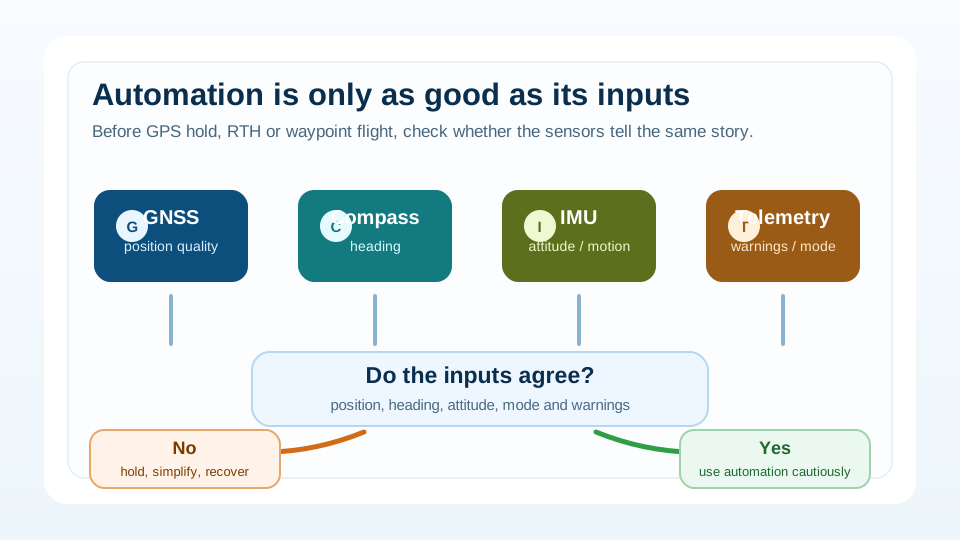
GPS hold, waypoint flight, return-to-home and many safety features depend on the aircraft's sensor picture. If that picture is wrong, the aircraft may confidently do the wrong thing.
The remote pilot's job is to cross-check the inputs before trusting the automation: position, heading, attitude, mode state, warnings and what the aircraft is actually doing in the sky.
GNSS position depends on satellite geometry and clean signals
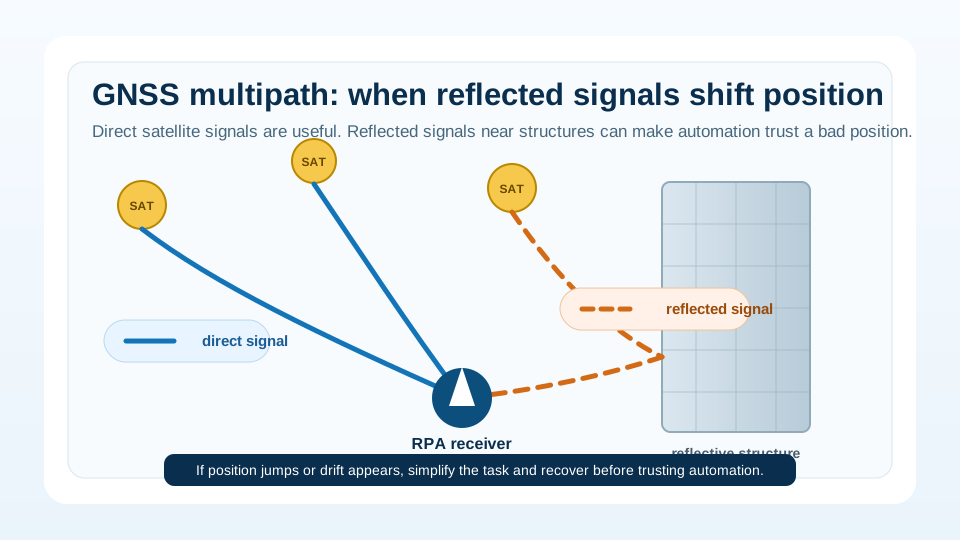
GNSS receivers estimate position from satellite signals. Accuracy depends on satellite geometry, receiver quality, antenna placement, signal strength, obstruction and the local environment.
A high satellite count is useful, but it is not the whole story. A receiver can still be affected by poor geometry, reflections, blockage or interference, especially near structures or terrain.
Multipath creates false confidence
Multipath occurs when satellite signals bounce off buildings, metal structures, vehicles, terrain or other reflective surfaces before reaching the receiver. The aircraft may receive both direct and reflected signals and calculate a position that is offset or unstable.
Remote pilots see this as drifting position hold, position jumps, poor mapping alignment, unexpected RTH behaviour or warnings that appear when flying near structures.
Compass interference changes the aircraft's idea of heading
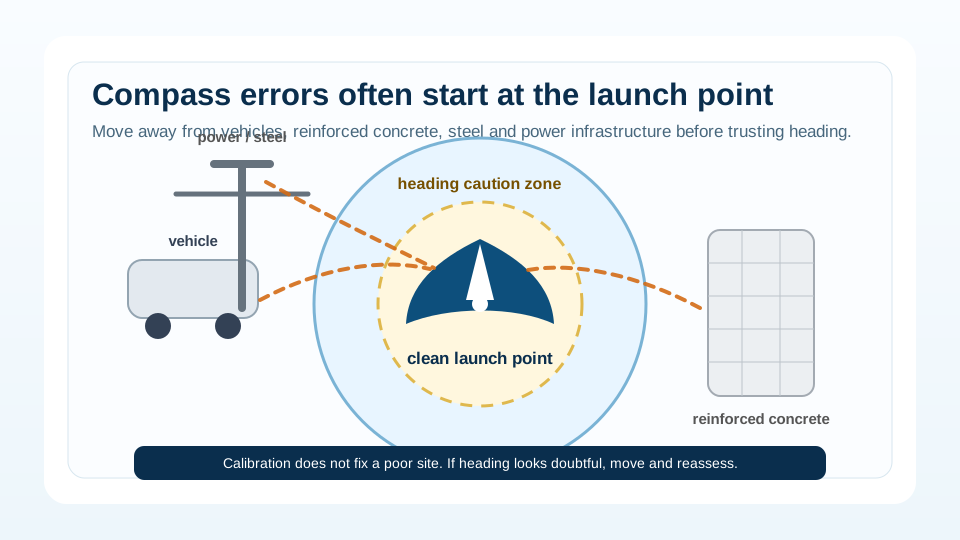
A compass gives heading information. It can be affected by magnetic fields from vehicles, reinforced concrete, steel structures, magnets, power infrastructure, payloads, batteries, cables and electrical equipment.
A poor compass environment can create toilet-bowling, yaw errors, incorrect RTH direction, unstable position hold or mode warnings. Calibration does not fix a bad launch location; sometimes the correct answer is to move.
IMU and barometer errors affect attitude and height confidence
The IMU helps the aircraft understand attitude and motion. Barometric and height systems help it estimate vertical movement. Vibration, shock, temperature, poor calibration or sensor disagreement can all reduce confidence.
The pilot may see this as poor hover stability, drifting height, unusual vibration warnings, inconsistent speed or mode limitations. Treat those signs as evidence, not as background noise.
Cross-check before relying on GPS hold or RTH
Before relying on GPS hold, return-to-home, geofence or waypoint flight, check whether the sensor picture is coherent. The map position should match the real site. The heading should match the aircraft orientation. The active mode should match the pilot's expectation. Telemetry should be free of unresolved warnings.
If the inputs do not agree, keep the aircraft close, simplify the operation, use the approved manual or degraded-mode procedure, and recover while there is still margin.
- Check home point, satellite/GNSS quality, heading, mode and warning state before take-off.
- Do not launch from vehicles, reinforced concrete, metal covers or obvious magnetic interference sources.
- Avoid pushing deeper into a task when position, heading or telemetry confidence is degrading.
Bad inputs can make good automation unsafe
Automation may behave perfectly according to bad inputs. A return-to-home using a wrong home point, wrong height, poor heading or unstable position can create a new hazard instead of solving the original one.
The safe mindset is simple: when the sensor picture becomes doubtful, the operation has changed. Recover, hold, relocate or move to an approved degraded-mode response before the aircraft decides for you.
Practice Questions
Why can automation become unsafe when sensors are unreliable?
- It may confidently act on wrong position, heading or mode information.
- Automation never uses sensors.
- Sensors only affect camera colour.
- A high battery percentage removes all sensor risk.
Answer: It may confidently act on wrong position, heading or mode information.
Automated modes depend on sensor inputs. Bad inputs can make a correct algorithm produce unsafe behaviour.
What is GNSS multipath?
- Satellite signals reflecting off structures or terrain before reaching the receiver.
- A special battery charging mode.
- A propeller balancing technique.
- A radio call used at controlled aerodromes.
Answer: Satellite signals reflecting off structures or terrain before reaching the receiver.
Reflected signals can make the receiver estimate an inaccurate or unstable position.
What is a good response to repeated compass or heading warnings before launch?
- Stop, investigate the site and aircraft, and move away from likely interference sources.
- Launch quickly before the warning returns.
- Ignore the warning because GPS will fix everything.
- Put the aircraft on a vehicle roof for a clearer view.
Answer: Stop, investigate the site and aircraft, and move away from likely interference sources.
Compass problems often come from the local environment, and calibration does not make a poor launch site safe.
What should a pilot cross-check before trusting return-to-home?
- Home point, position quality, heading, RTH height, obstacles, mode and warnings.
- Only the aircraft colour.
- Only the memory card capacity.
- Only the payload brand.
Answer: Home point, position quality, heading, RTH height, obstacles, mode and warnings.
RTH relies on several assumptions. Each needs to match the site and aircraft state.
Next step after study
Complete your Remote Pilot Licence training
The free study guide is a strong theory foundation. To actually be issued with a RePL, students still complete approved training, practical flying and assessment with a certified provider.