AI-Powered Drone Inspections: What Asset Owners Need to Know
18 March 2026
AI-Powered Drone Inspections: What Asset Owners Need to Know
There's no shortage of hype around AI. Every technology vendor in the asset management space seems to have bolted the letters "AI" onto their product, and the promises can be hard to separate from reality. Automated defect detection. Predictive maintenance. Digital twins that think for themselves. It all sounds impressive in a pitch deck.
But if you're the person responsible for keeping a fleet of transmission towers upright, a tailings dam stable, or a plantation productive, you need more than impressive. You need practical. You need to know what actually works, what's still experimental, and what's worth investing in today versus waiting for the technology to mature.
This article is an attempt at an honest assessment. We've been flying drones for asset inspection across Australia for years, and we've seen firsthand where AI delivers genuine value and where it falls short. Here's what we've learned.
What AI Actually Does in a Drone Inspection Workflow
Let's strip away the jargon and talk about what AI practically does when applied to drone inspection data. At its core, AI in this context is pattern recognition at scale. You're taking tasks that a human expert could do -- look at an image, identify a defect, classify its severity, decide what to do about it -- and teaching a computer to do the same thing, but across thousands or millions of data points.
The typical workflow looks something like this:
- Data capture -- A drone flies over or around the asset, collecting imagery, thermal data, LiDAR point clouds, or some combination of these
- Data processing -- Raw sensor data is processed into usable formats -- orthomosaics, 3D models, thermal maps, classified point clouds
- AI analysis -- Machine learning models scan the processed data, identifying and classifying features of interest
- Human review -- A qualified inspector reviews the AI's findings, validates detections, adds context, and makes maintenance recommendations
- Reporting and action -- Validated findings are compiled into reports or fed directly into asset management systems as work orders
The critical thing to notice here is step 4. In almost every real-world application today, AI assists human inspectors rather than replacing them. The AI does the tedious work of screening thousands of images to find the handful that contain defects. The human expert then applies judgement, context, and experience to decide what those defects mean and what should be done about them.
This human-in-the-loop approach isn't a limitation of the technology -- it's a feature. Asset inspection decisions often have significant safety and financial consequences, and maintaining human oversight is both prudent and, in many regulatory frameworks, required.
Where AI Delivers Clear Value Today
Powerline and Pole Inspection
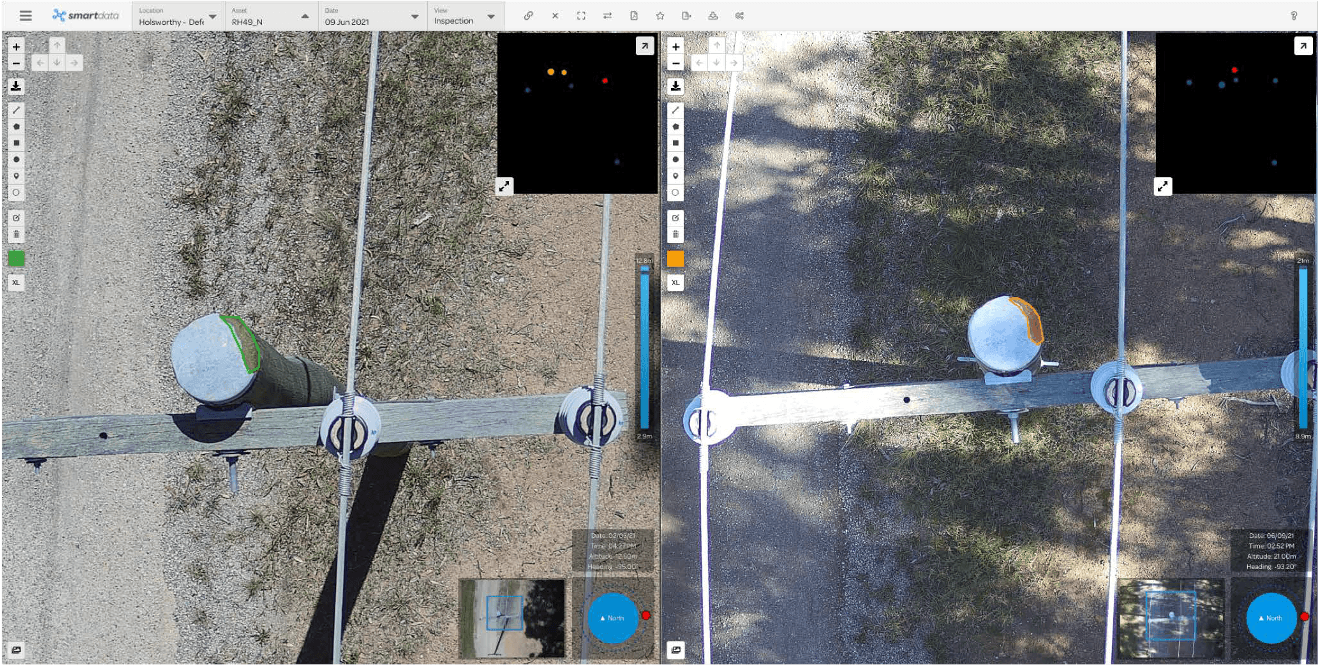
This is one of the most mature applications of AI in drone inspection, and for good reason. Australia's distribution network alone includes millions of power poles, each of which needs periodic inspection. The volume of imagery generated by drone inspection programs is simply too large for human review -- you might capture 200 images per pole across a fleet of hundreds of thousands of poles.
AI models trained on defect libraries can reliably detect:
- Woodpecker damage and rot in timber poles (less relevant in Australia, but common in models trained on international datasets)
- Cracks and splits in timber and concrete poles
- Lean beyond acceptable tolerances
- Crossarm deterioration -- splits, end-grain decay, bolt corrosion
- Insulator damage -- chips, cracks, flashover marks
- Vegetation encroachment into clearance zones
- Missing or damaged hardware -- bolts, ties, pins, and fittings
The accuracy of these models varies, but the best commercial systems are achieving detection rates above 90 percent for common defect types, with false positive rates low enough that the human review burden is manageable. That's a significant improvement over ground-based visual inspection, which research has shown misses a substantial proportion of defects that are only visible from above or at close range.
Thermal Anomaly Detection
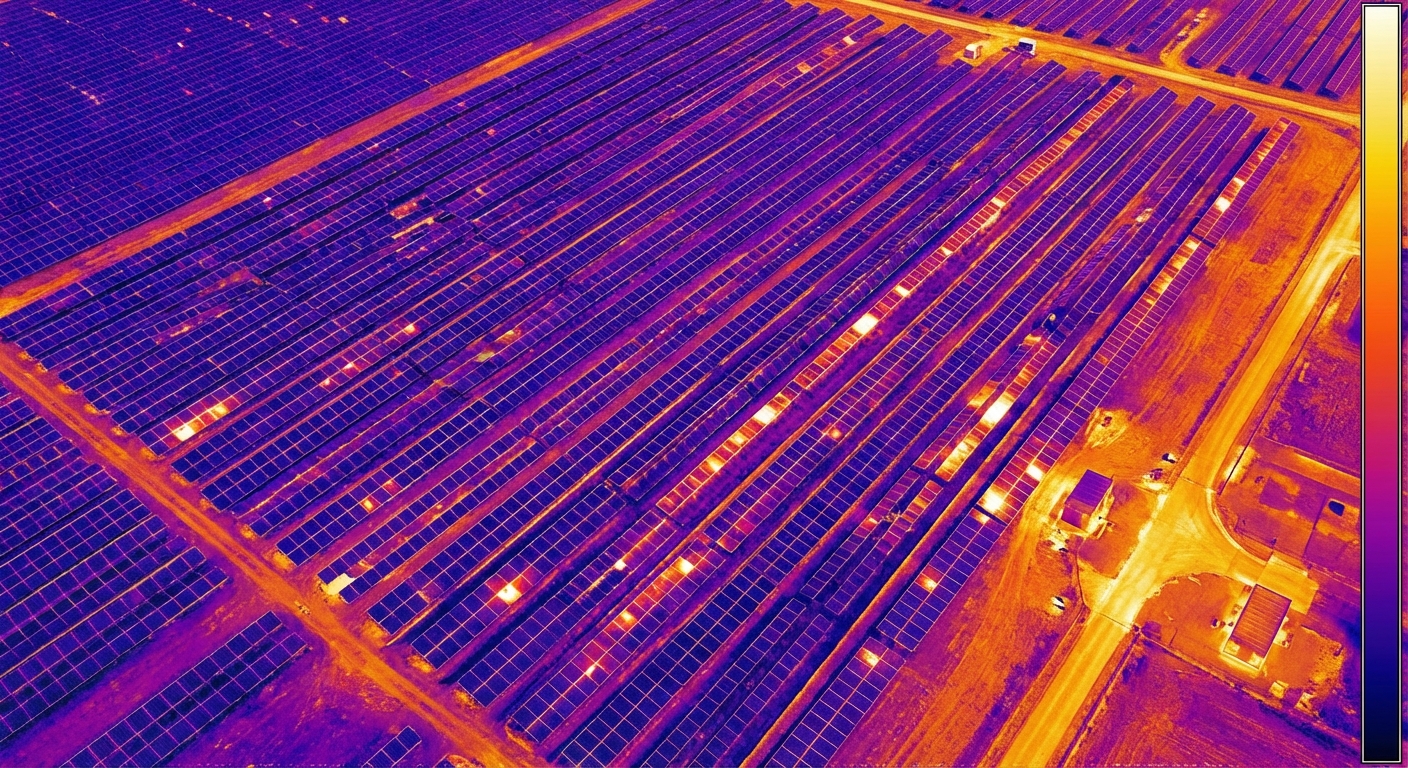
Thermal inspection is another area where AI excels, partly because thermal anomalies are relatively unambiguous. A hotspot on an electrical connection either exists or it doesn't, and the temperature differential is quantifiable.
AI applied to radiometric thermal imagery can:
- Automatically detect temperature anomalies above configurable thresholds
- Classify anomalies by component type (connection, insulator, transformer, etc.)
- Calculate delta-T values relative to ambient and reference temperatures
- Track anomaly progression across multiple survey periods
- Generate prioritised work lists based on severity
For solar farm inspections, thermal AI can scan thousands of panels in a single flight and identify underperforming cells, bypass diode failures, hotspots, and soiling patterns. A solar farm inspection that might take a ground crew a week can be completed by drone in a day, with AI processing the imagery overnight to deliver a defect report the following morning.
Volumetric Measurement
AI-assisted volumetric measurement from drone-captured data is well-established, particularly in mining and earthworks. Dense photogrammetric point clouds or LiDAR scans provide the raw geometry, and AI algorithms handle the surface fitting, boundary delineation, and volume calculation.
The accuracy of drone-based volumetric measurement is well-documented. Studies consistently show agreement within 1 to 3 percent of ground-truth measurements, which is comparable to or better than traditional survey methods for most practical purposes.
Where AI adds particular value is in automating the process for repeated measurements. Once the stockpile boundaries and reference surfaces are defined, subsequent surveys can be processed automatically, delivering volume change reports without manual intervention.
Vegetation Classification and Monitoring
Multispectral and LiDAR data captured by drones provides rich information about vegetation health, species composition, and structure. AI models can:
- Classify tree species from canopy spectral signatures and structural characteristics
- Detect vegetation stress from subtle changes in spectral reflectance that precede visible symptoms
- Measure canopy height and density from LiDAR point clouds
- Estimate biomass and timber volumes using allometric models calibrated with ground-truth data
- Monitor weed invasion by identifying non-native species in multispectral imagery
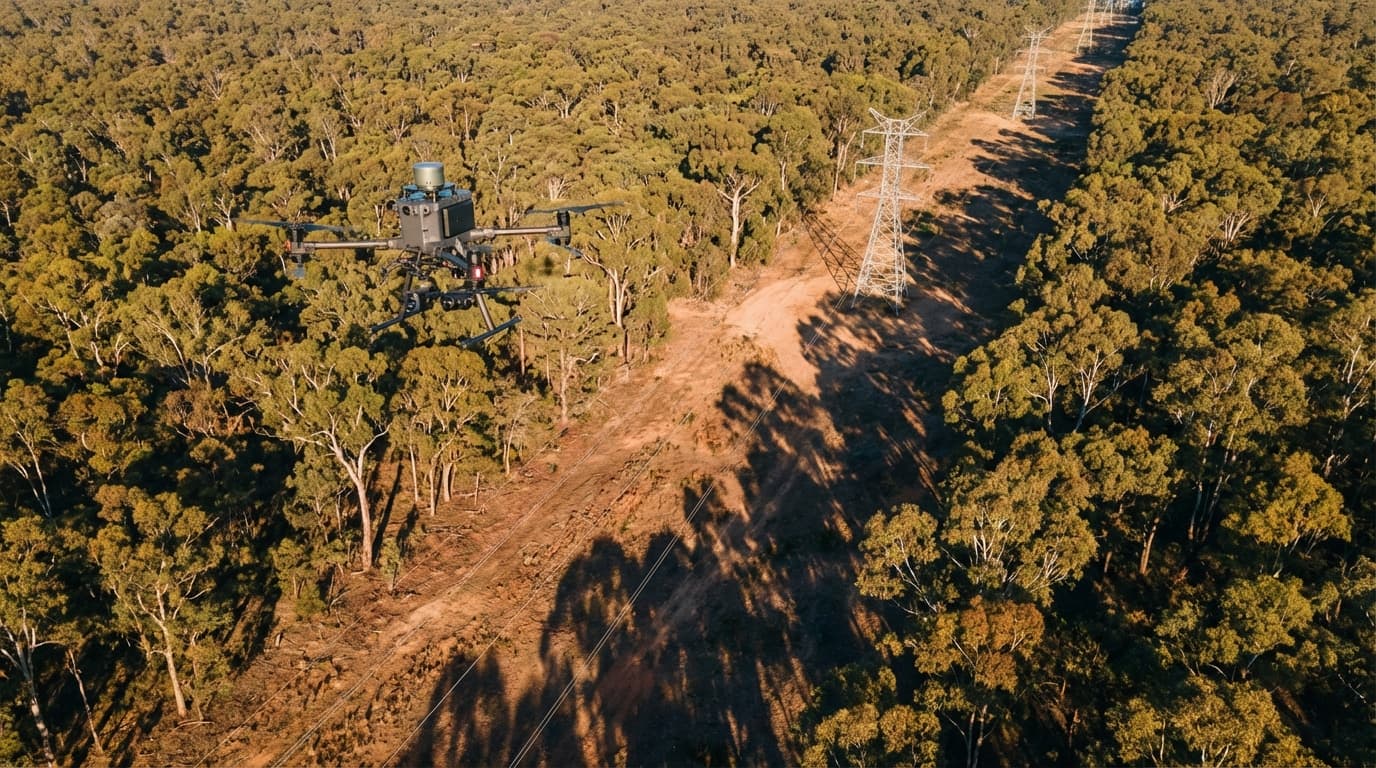
For forestry operations, this means more accurate inventory, earlier detection of pest and disease issues, and better-informed harvesting decisions. For vegetation management around infrastructure, it means risk-based clearance programs that target the right trees at the right time.
Where AI Still Struggles
It's important to be honest about the limitations. AI isn't magic, and there are areas where the technology isn't yet reliable enough to trust without significant human oversight.
Novel Defect Types
AI models are trained on historical data. They're good at finding defects that look like the defects they were trained on. But genuinely novel failure modes -- things the model has never seen before -- may be missed entirely. This is why human review remains essential and why training datasets need to be continuously updated as new defect types are encountered.
Context and Consequence
An AI model can tell you that a crack exists and estimate its dimensions. What it can't easily do is assess the structural significance of that crack in context. Is it in a load-bearing member? Is it propagating? What are the consequences of failure? These questions require engineering judgement that current AI models don't possess.
The best systems address this by combining AI detection with rule-based consequence frameworks. The AI identifies the defect; the rules engine assesses the risk based on asset criticality, defect location, and historical failure data. But the rules still need to be defined by human experts, and edge cases still need human review.
Inconsistent Conditions
AI models can be sensitive to variations in lighting, weather, sensor calibration, and flight parameters. A model trained on imagery captured in clear conditions at midday may perform poorly on data collected on an overcast afternoon or at dawn. Shadows, glare, wet surfaces, and atmospheric haze all affect model performance.
Robust AI systems account for these variations through diverse training data and normalisation techniques, but it's an ongoing challenge. Operators who standardise their capture conditions -- consistent altitude, overlap, time of day, and sensor settings -- generally get better AI results than those who don't.
Small Datasets
Training effective AI models requires large, well-labelled datasets. For common asset types like power poles and solar panels, sufficient training data exists. But for less common or highly specialised assets, the available training data may be insufficient to build reliable models.
This is gradually improving as more organisations share data and as transfer learning techniques allow models trained on one asset type to be adapted for another. But for niche applications, expect to invest in building your own training dataset before AI can deliver reliable results.
Building a Business Case
If you're considering AI-powered drone inspections for your asset portfolio, here's a practical framework for building the business case.
Quantify Your Current Inspection Costs
Start by understanding what you're spending now. Include direct costs (labour, equipment, access, travel) and indirect costs (production downtime during inspections, traffic management, risk exposure). For many organisations, the true cost of inspection is significantly higher than the direct cost alone.
Identify the Value Drivers
The value of AI-powered drone inspection typically comes from several sources:
- Reduced inspection cost -- Fewer person-hours per asset inspected, less equipment hire, less travel
- Improved defect detection -- Finding defects that would be missed by traditional methods, reducing unplanned failures
- Better prioritisation -- Risk-based maintenance scheduling that directs spend where it has the most impact
- Faster turnaround -- Shorter time from inspection to actionable intelligence
- Improved safety -- Fewer people in hazardous environments
Start Small and Prove Value
Don't try to transform your entire inspection program overnight. Pick a specific asset class, run a pilot program, and measure the results against your existing method. A well-designed pilot gives you the data to build a compelling business case for broader adoption and identifies any integration challenges before you scale.
Plan for Data Integration
The long-term value of AI-powered inspection data is maximised when it integrates with your existing asset management systems. Consider how defect data will flow from the AI platform into your maintenance planning and work order systems. The organisations getting the most value from this technology are the ones who've closed the loop between detection and action.
What to Look for in a Drone Inspection Provider
Not all drone inspection services are equal, and the AI capabilities on offer vary enormously. Here are some questions worth asking:
- What AI models do you use, and what are their validated accuracy rates? -- Be wary of providers who can't answer this question specifically. Ask for confusion matrices, not marketing materials.
- How is your training data sourced and labelled? -- Model quality depends on training data quality. Understanding the provenance of training data tells you a lot about how much you can trust the model's outputs.
- What's the human review process? -- Any provider claiming fully automated defect detection with no human review should be treated with healthy scepticism, at least for safety-critical assets.
- How do you handle edge cases and novel defects? -- Ask about their process for flagging uncertain detections and updating models with new defect types.
- Can you integrate with our existing systems? -- Data that lives in a standalone platform and can't be exported into your asset management system has limited long-term value.
- What regulatory approvals do you hold? -- Ensure they have the appropriate RePL, ReOC, and any area-specific approvals (BVLOS, controlled airspace, etc.) required for your operations.
The Bottom Line
AI-powered drone inspection is real, it works, and it's delivering measurable value across a range of Australian industries. But it's a tool, not a silver bullet. The organisations getting the most out of it are the ones approaching it pragmatically -- starting with clear objectives, measuring results honestly, maintaining appropriate human oversight, and investing in data integration.
The technology will continue to improve. Detection accuracy will get better. Processing will get faster. Autonomous operations will expand the range of what's possible. But the fundamentals of good asset management haven't changed: know what you've got, understand its condition, and maintain it based on risk and evidence.
Drones and AI are making all three of those fundamentals easier, cheaper, and more reliable. That's not hype -- it's just good engineering.
If you'd like to discuss how AI-powered drone inspections could work for your asset portfolio, reach out to our team. We're happy to share our experience and help you figure out whether the technology makes sense for your situation.