
Edith Cowan University
Updating Asset Registers and Reducing Risks
National Drones assists BGIS (Edith Cowan University's facilities management partner) in delivering operational efficiencies and improving building management and asset lifecycle through safe, rapid structural fault and maintenance issue identification.
BGIS utilises emerging technologies to solve infrastructure challenges. By partnering with National Drones for external building inspections, they provide comprehensive property overviews with detailed defect visibility. Remotely piloted aircraft systems minimise or eliminate worker height exposure by capturing high-definition evidence of defects in parapets, gutters, lashing, pointing, roofing materials, skylights, and high-rise windows.
The Challenges
Preventative maintenance extends building and infrastructure asset lifespan, yet manual inspections are labour-intensive, time-consuming, and hazardous. Such work often requires elevated platforms, scaffolding, harnesses, or abseiling — high-risk activities demanding substantial resources and planning. Falling from height ranks as the third-leading workplace fatality cause in Australia, representing 13% of worker fatalities in 2015.
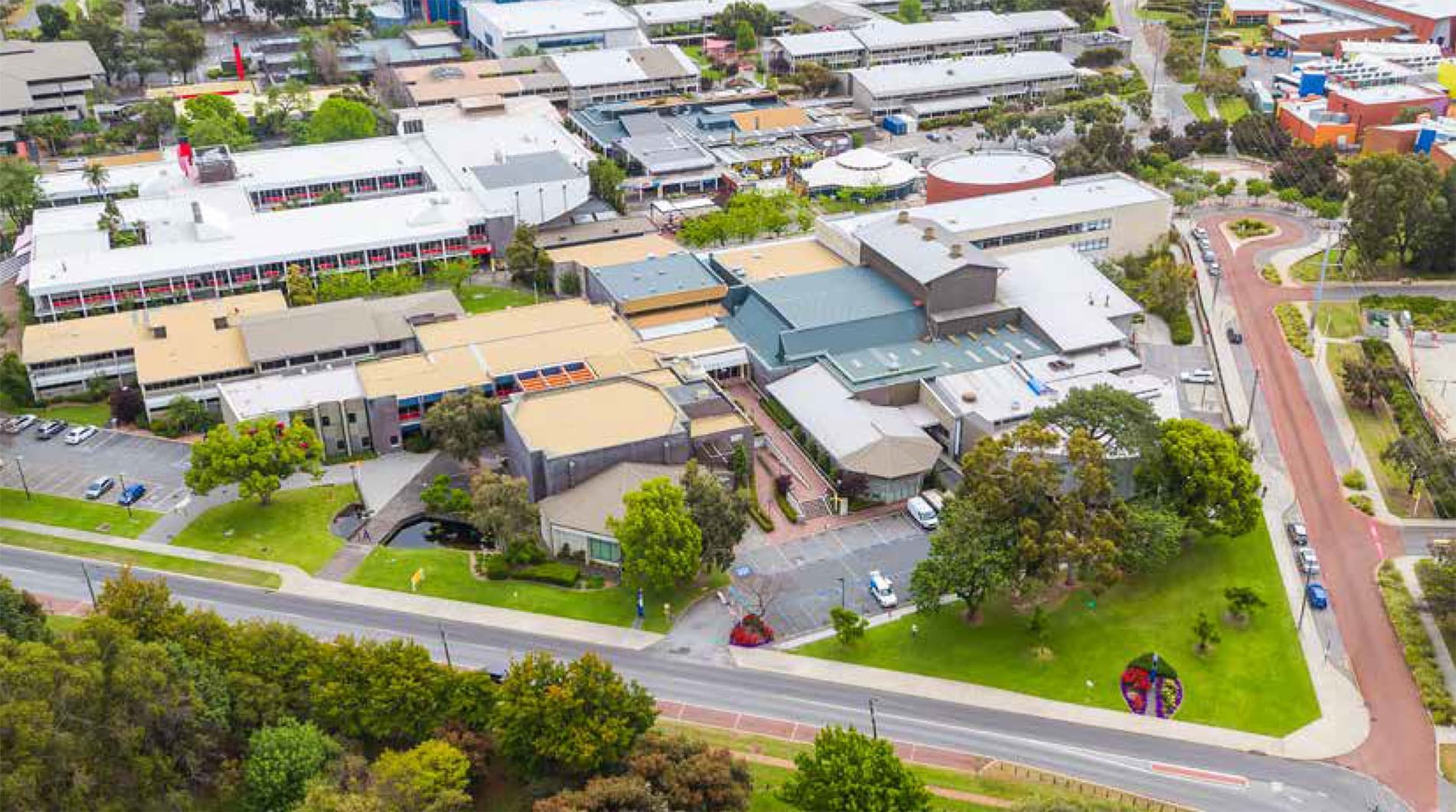
The "WAAPA" building at ECU's Mount Lawley campus experienced prolonged, multiple issues causing water ingress and damage. Repeated leak identification and repair attempts proved unsuccessful.
The Solution
- Aerial photomosaic inspection survey — UAV high-resolution image/mapping asset data capture of complete roof structure
- Desktop asset and defect identification — Captured aerial imagery post-processed into high-resolution, geo-referenced orthomosaic mapping
- Desktop inspection and asset survey — Captured data safely analysed from ground by building inspectors, property managers, surveyors, architects, or technical specialists
- Work order generation — Maintenance workers receive precise defect location and description, reducing ground time, risk, and insurance costs
- Temporal comparison — Quarterly, semi-annual, or annual surveys track building/asset condition changes, enabling preventative maintenance and accurate budgeting while confirming completed work
The Results
The UAV-based inspection identified 37 faults and issues, including:
- Debris blocking downpipes and gutters
- Flashing around roof services not meeting Australian Building Code standards, causing water ingress
- Insufficient gutter fall/gradient leading to water ingress
- Roof sheet damage, likely from trades working on roof
- Building/construction material left on roof surfaces
- Incorrect gutter installation and insufficient rainwater drainage
Recommendations addressed each fault/issue's rectification or further investigation methods. ECU was recommended for aerial inspection across all three Western Australian campuses.
Next Steps
In early 2018, BGIS and ECU partnered with National Drones to assess feasibility and methodology for comprehensive roof and facade inspections on 80 university buildings across three Western Australian sites.
Benefits for BGIS & ECU
- Reduced field operations time required for asset inspections from days to hours, significantly reducing WH&S issues
- Optimised allocation of on-site resources for proactive issue investigation and resolution, instead of time-consuming data collection and reactive work
- Improved asset register and clearer understanding of overall building "health" and how structures and issues change over time
- Enhanced online data availability for stakeholders, allowing for early identification of potential issues and ensuring remedial work carried out correctly