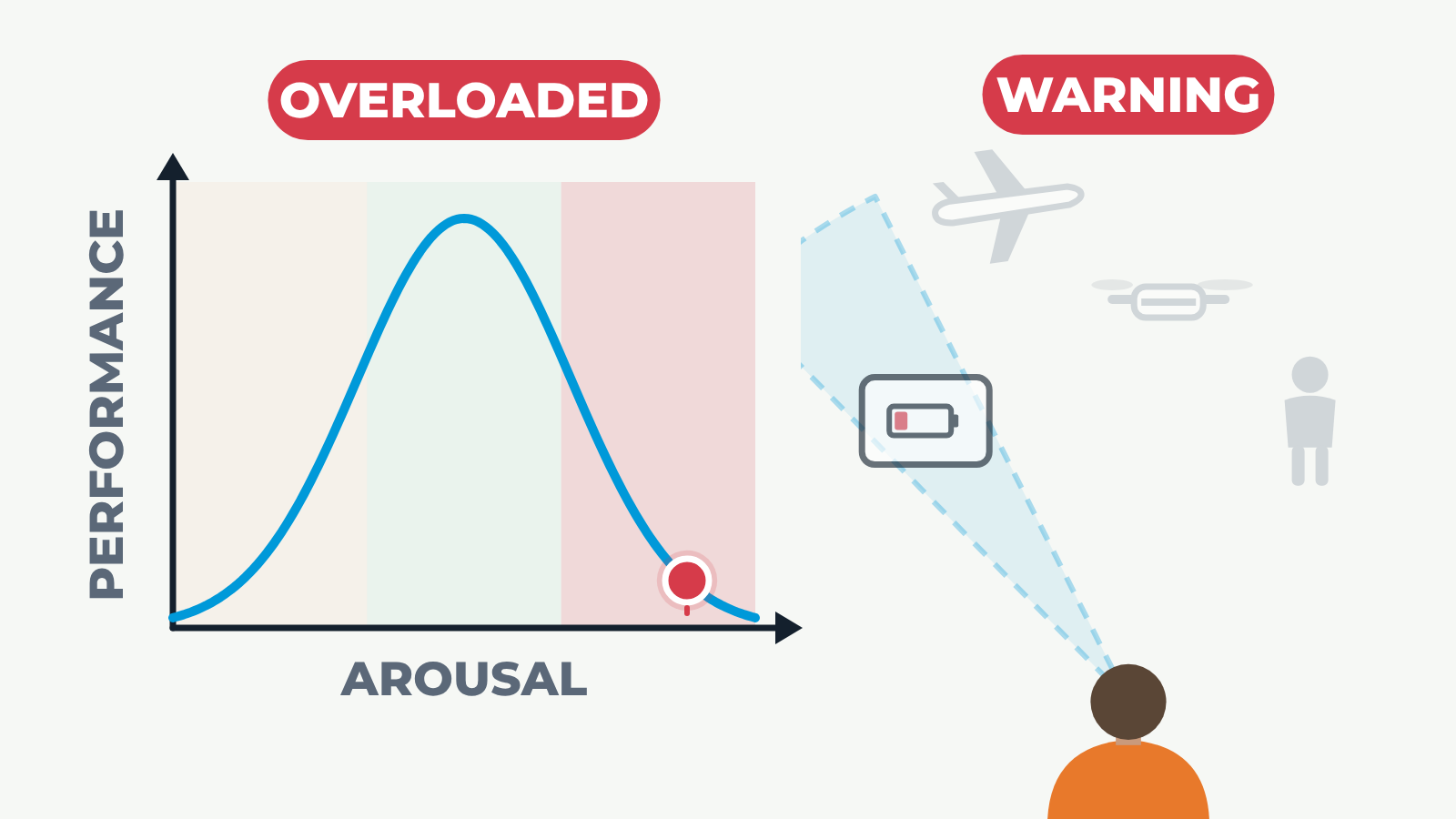
Left: the Yerkes-Dodson curve, performance against arousal, an inverted U. A marker rides the curve. Low arousal is the bored, complacent zone; the middle is the ideal zone; high arousal is overload, with anxiety and tunnel vision. Right: a remote pilot seen from behind, with an attention cone over four cues: the telemetry screen, a crewed aircraft, the drone and a bystander. In the loop the pilot starts bored, so the cues are faint. Arousal rises to the ideal zone and all four cues are bright inside a wide cone. A warning then appears on the telemetry screen, stress pushes the marker into overload, and the cone narrows onto the screen: the aircraft, the drone and the bystander fall outside it and fade. A checklist pulls the marker back to the ideal zone and the cone widens again. Use the stress slider to set the level yourself, and the "Apply a countermeasure" button (a checklist, slowing down or a stop-work call) to pull it back towards the ideal zone. The curve is qualitative; it has no units.